
SSI Benefits 2026: What the Latest Cost-of-Living Adjustment (COLA) Means for Your Monthly Payments
For millions of Americans who rely on Supplemental Security Income (SSI), understanding the future of their benefits is paramount. As we look ahead to 2026, one of the most critical factors influencing these payments is the Cost-of-Living Adjustment (COLA). This annual adjustment is designed to help benefits keep pace with inflation, ensuring that recipients maintain their purchasing power. But what exactly will the SSI Benefits 2026 look like, and how will the COLA impact your monthly payments? This comprehensive guide will delve into the intricacies of SSI, the COLA calculation, and what beneficiaries can anticipate in the coming years.
The Foundation of SSI: A Lifeline for Millions
Supplemental Security Income (SSI) is a federal program administered by the Social Security Administration (SSA) that provides financial assistance to low-income individuals who are aged 62 or older, blind, or disabled. Unlike Social Security retirement or disability benefits, SSI is not based on prior work history or contributions to Social Security taxes. Instead, it is a needs-based program, meaning eligibility and payment amounts are determined by an individual’s income, resources, and living arrangements.
The primary goal of SSI is to provide a minimum level of income for those who are unable to support themselves due to age, blindness, or disability. This program serves as a critical safety net, helping beneficiaries cover essential living expenses such as food, shelter, and medical care. Understanding the nuances of SSI is the first step in appreciating the significance of any adjustments, particularly the annual COLA.
Eligibility for SSI is stringent and requires applicants to meet specific criteria. Income limits are a crucial component; generally, countable income must fall below a certain threshold. Resources, such as cash, bank accounts, and certain assets, are also capped. For an individual, the resource limit is typically $2,000, while for a couple, it’s $3,000. These limits are designed to ensure that the program targets those with the most significant financial need.
Furthermore, the definition of disability for SSI purposes is quite strict. An individual must be unable to engage in any substantial gainful activity (SGA) due to a medically determinable physical or mental impairment that is expected to last for at least 12 months or result in death. Blindness is defined as central visual acuity of 20/200 or less in the better eye with the use of a correcting lens, or a visual field limitation such that the widest diameter of the visual field subtends an angle no greater than 20 degrees.
The importance of SSI cannot be overstated. It provides a foundational income for some of the most vulnerable members of society, helping to alleviate poverty and improve quality of life. Any changes to the program, especially those impacting monthly payment amounts, have a profound effect on the daily lives of millions of beneficiaries. This is where the Cost-of-Living Adjustment plays a pivotal role in maintaining the program’s effectiveness over time.
Deciphering the Cost-of-Living Adjustment (COLA)
The Cost-of-Living Adjustment (COLA) is an annual increase in Social Security and SSI benefits to offset the effects of inflation. Its purpose is to ensure that the purchasing power of these benefits is not eroded by rising prices for goods and services. Without COLA, beneficiaries would find their fixed incomes buying less and less each year, making it increasingly difficult to meet their basic needs.
The COLA is determined by the Social Security Administration (SSA) based on changes in the Consumer Price Index for Urban Wage Earners and Clerical Workers (CPI-W). Specifically, the SSA compares the average CPI-W for the third quarter (July, August, and September) of the current year with the average for the third quarter of the previous year. The percentage increase, if any, between these two periods becomes the COLA for the following year. For example, the COLA for 2026 will be based on the CPI-W data from the third quarter of 2025 compared to the third quarter of 2024.
It’s important to note that if there is no increase in the CPI-W, there will be no COLA for that year. This has happened in the past, though it is relatively rare. When a COLA is announced, it applies to both Social Security benefits and SSI benefits, ensuring that both programs keep pace with economic changes.
While the COLA is a vital mechanism, it’s not without its critics. Some argue that the CPI-W, which primarily tracks the spending habits of urban wage earners, does not accurately reflect the consumption patterns and cost burdens faced by seniors and disabled individuals, who often have higher healthcare costs and different spending priorities. Alternative indices, such as the Consumer Price Index for the Elderly (CPI-E), have been proposed, but the CPI-W remains the standard for COLA calculations.
Despite these debates, the COLA remains the primary tool for adjusting benefits to inflation. Its impact on SSI Benefits 2026 will be a direct reflection of economic conditions in the preceding year. A higher inflation rate typically leads to a larger COLA, while lower inflation results in a smaller adjustment. Understanding this mechanism is crucial for beneficiaries to anticipate changes to their monthly payments and plan their finances accordingly.
Projecting the 2026 COLA: What Influences the Numbers?
Predicting the exact COLA for 2026 at this stage is speculative, as it depends on economic data that will not be available until late 2025. However, we can discuss the factors that typically influence these projections and provide a framework for understanding potential outcomes. The primary driver, as mentioned, is inflation, specifically as measured by the CPI-W.
Several economic indicators and trends can hint at the direction of inflation. These include:
- Energy Prices: Fluctuations in oil and gas prices directly impact transportation costs and utility bills, which are significant components of the CPI-W.
- Food Costs: Changes in agricultural production, supply chain issues, and global demand can lead to shifts in food prices, another major contributor to inflation.
- Housing Costs: Rent and homeownership expenses are substantial for many households. Rising housing costs can exert upward pressure on the overall CPI-W.
- Wage Growth: While not a direct component of the CPI-W, strong wage growth can contribute to increased consumer demand, potentially leading to higher prices.
- Global Economic Conditions: International events, trade policies, and geopolitical stability can all affect supply chains and commodity prices, thus influencing domestic inflation.
- Federal Reserve Policies: The Federal Reserve’s monetary policy decisions, such as interest rate adjustments, aim to manage inflation. Their actions can have a ripple effect on the economy and, consequently, on the CPI-W.
Economic forecasts from various organizations, including the Congressional Budget Office (CBO), the Federal Reserve, and private financial institutions, often provide projections for inflation rates. While these are not official COLA predictions, they can offer insights into the expected economic environment that will shape the 2026 COLA. For instance, if economists widely anticipate moderate inflation in 2025, it’s reasonable to expect a modest COLA for 2026. Conversely, a forecast of higher inflation could signal a more substantial COLA.
Historically, COLA percentages have varied significantly, ranging from 0% in some years to over 10% during periods of high inflation. The trend in recent years has seen more moderate adjustments, though there have been notable exceptions. As we approach late 2025, more accurate predictions for the 2026 COLA will emerge as the critical CPI-W data becomes available. Beneficiaries should pay close attention to economic news and official announcements from the SSA during that time.
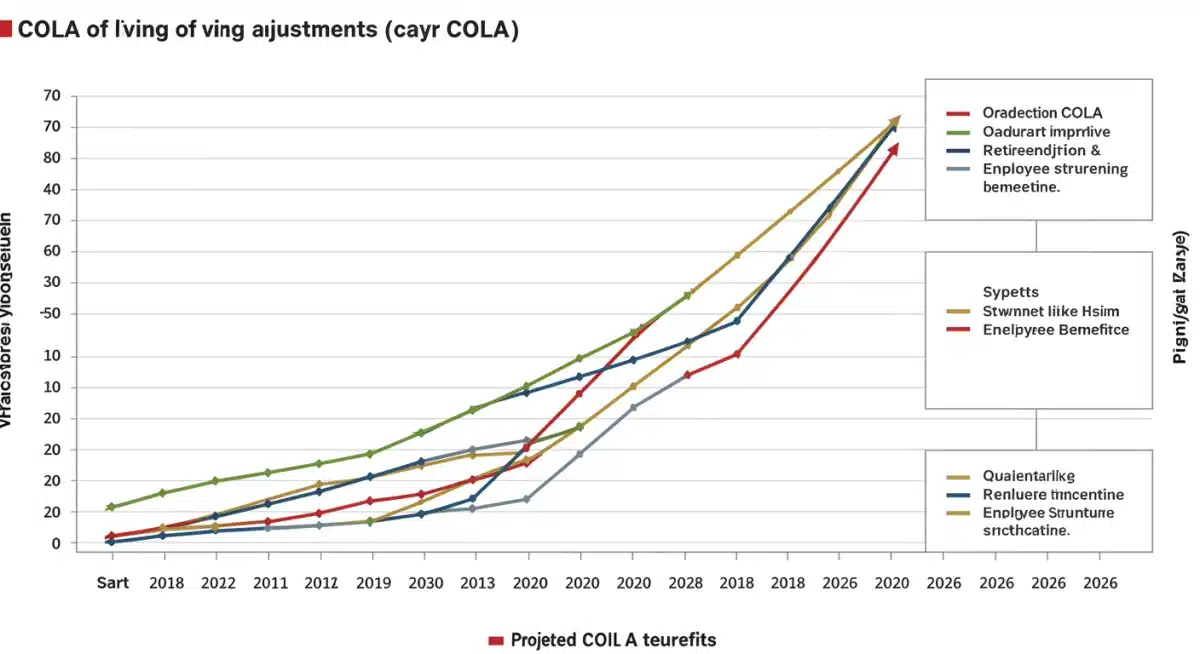
Impact of COLA on Your SSI Monthly Payments in 2026
Once the 2026 COLA is announced, it will directly affect the maximum federal SSI payment amount. For instance, if the maximum federal benefit for an individual in 2025 is $914 per month, and the 2026 COLA is, for example, 3%, then the new maximum federal benefit would be approximately $941.42. This new amount would then be rounded to the nearest dollar, becoming the baseline for individual payments.
It’s crucial to remember that the COLA applies to the maximum federal benefit rate. The actual payment an individual receives can be lower than this maximum, depending on their countable income and living arrangements. SSI is a ‘payer of last resort’ program, meaning that other income sources are generally subtracted from the maximum federal benefit amount.
For example, if an SSI recipient has $100 in countable income (after certain exclusions), their monthly SSI payment would be the maximum federal benefit minus that $100. So, if the maximum federal benefit is $941 in 2026, and they have $100 in countable income, their payment would be $841. This means that while the COLA increases the potential benefit, the net increase for some individuals might be less significant if their other income sources also increase or if they have substantial countable income.
Furthermore, some states provide a State Supplementary Payment (SSP) in addition to the federal SSI benefit. These state supplements vary widely and are not directly impacted by the federal COLA. However, some states may choose to adjust their SSPs in response to federal changes or their own economic conditions. Beneficiaries living in states with SSPs should inquire with their state social services agencies for specific information regarding state-level adjustments.
The COLA’s impact extends beyond just the monthly payment amount. It can also affect the income and resource limits for certain SSI eligibility criteria. While the core resource limits ($2,000 for individuals, $3,000 for couples) typically remain stable for extended periods, other income exclusions and thresholds might see minor adjustments over time. The SSA will release comprehensive details about all updated figures once the COLA is finalized.
For beneficiaries, the COLA is more than just a number; it represents the SSA’s effort to keep pace with the real-world costs of living. A higher COLA can provide much-needed relief from rising expenses, while a lower or non-existent COLA can pose financial challenges. Therefore, staying informed about the COLA projections and the final announcement is vital for effective financial planning.
Navigating Income and Resource Limits with SSI Benefits 2026
Understanding income and resource limits is fundamental to maintaining SSI eligibility, and these limits often interact with COLA adjustments. As previously mentioned, the resource limit generally remains fixed at $2,000 for an individual and $3,000 for a couple. These limits are rarely adjusted by COLA and require careful management by beneficiaries.
Income, however, is a more dynamic factor. The SSA distinguishes between earned income (from wages or self-employment) and unearned income (such as pensions, Social Security benefits, or gifts). Not all income is counted dollar-for-dollar against your SSI benefit. The SSA has various exclusions and deductions designed to encourage work and account for necessary expenses.
For example, the first $20 of most unearned income per month is generally excluded. For earned income, the first $65 per month plus half of the remaining earnings are excluded. This means that for every two dollars earned above the $65 threshold, only one dollar reduces your SSI payment. This ‘earned income exclusion’ is a powerful incentive for SSI recipients to work, as it allows them to keep a significant portion of their earnings without losing all their benefits.
The maximum federal benefit rate, which is directly impacted by the COLA, plays a critical role in determining how much SSI you receive after countable income is considered. If the SSI Benefits 2026 maximum increases due to COLA, it means you can potentially have slightly more countable income before your SSI payment is reduced to zero. This subtle interaction is important for beneficiaries who have some form of income.
It’s also important to be aware of the ‘in-kind support and maintenance’ rules. If someone else pays for your food or shelter, or provides it to you for free, the SSA may count the value of that support as income, which could reduce your SSI payment. This is a complex area, and beneficiaries often need to report changes in their living arrangements to the SSA promptly.
Maintaining eligibility for SSI requires diligent reporting of income, resources, and living arrangements. Failure to report changes accurately and timely can lead to overpayments, which the SSA will then seek to recover, often by reducing future benefits. As the COLA adjusts the maximum federal benefit, it’s a good time for beneficiaries to review their financial situation and ensure they are compliant with all SSA reporting requirements, especially as new limits for SSI Benefits 2026 come into effect.
The Broader Economic Landscape and SSI Benefits
The determination of SSI Benefits 2026 and the COLA is not an isolated event; it is deeply intertwined with the broader economic landscape. Factors such as national inflation rates, employment levels, and global economic stability all play a role in shaping the economic conditions that influence the COLA. A robust economy with low unemployment might see moderate inflation, leading to a steady COLA. Conversely, periods of high inflation, often triggered by supply chain disruptions or increased demand, can result in more substantial COLA increases.
The Federal Reserve’s monetary policy, specifically its decisions on interest rates, also has a significant impact. When the Fed raises interest rates to combat inflation, it aims to slow economic growth and reduce price pressures. These actions can indirectly influence the CPI-W and, consequently, the COLA. For SSI beneficiaries, understanding these broader economic forces can provide context for why their benefits are adjusted in a particular way. For example, if interest rates have been high in 2025, it might signal an attempt to curb inflation, potentially leading to a more moderate COLA for 2026 if those efforts are successful.
Government fiscal policy, including spending and taxation, can also influence economic conditions and inflation. Large government spending programs, if not offset by revenue, can inject more money into the economy, potentially leading to increased demand and higher prices. Conversely, austerity measures might slow economic growth and dampen inflation. While these are broad economic theories, their practical application can be seen in the annual COLA calculation.
The health of the social security trust funds, while not directly impacting SSI (which is funded by general tax revenues, not the trust funds), often influences the political discourse around benefits. Discussions about the solvency of Social Security can sometimes spill over into broader conversations about federal benefit programs, including SSI. However, it’s critical to distinguish between Social Security and SSI when discussing funding mechanisms.
For individuals relying on SSI Benefits 2026, these economic factors translate into real-world implications for their daily budgets. A higher COLA means more purchasing power, which is crucial when grocery prices or utility costs are rising. A lower COLA, on the other hand, can make it challenging to keep up with expenses, especially for those with no other sources of income. Therefore, monitoring economic news and understanding its potential impact on the COLA is a proactive step for beneficiaries.
How to Stay Informed About SSI Benefits 2026
Staying informed about the latest developments regarding SSI Benefits 2026 is crucial for effective financial planning. The Social Security Administration (SSA) is the primary source of official information, and they make announcements well in advance of any changes taking effect.
Here are the best ways to stay updated:
- Official SSA Website: The Social Security Administration’s official website is the most authoritative source for information regarding SSI benefits, COLA announcements, and eligibility requirements. They typically publish the new COLA percentage in October each year, with the updated benefit amounts taking effect in January of the following year.
- My Social Security Account: If you are an SSI recipient, you can create a My Social Security account online. This personalized account allows you to check your benefit statement, review your earnings record, and receive important updates directly from the SSA.
- Official Correspondence: The SSA will send out official notices to beneficiaries detailing any changes to their monthly payment amounts, usually in December, before the new COLA takes effect in January. It’s important to read these notices carefully.
- Trusted News Sources: Reputable financial news outlets and disability advocacy organizations often report on COLA predictions and announcements, providing analysis and context. Be sure to rely on well-established sources for accurate information.
- Local Social Security Office: If you have specific questions about your individual benefits or need assistance, your local Social Security office can provide personalized guidance. It’s often advisable to call ahead for an appointment.
Beyond the COLA, it’s also important to stay informed about any potential legislative changes that could impact SSI. While the core structure of SSI is relatively stable, lawmakers occasionally propose adjustments to eligibility rules, income exclusions, or benefit calculations. While less frequent than COLA changes, these legislative developments can have a significant long-term impact on the program and its beneficiaries.
Proactive engagement with information resources ensures that beneficiaries are prepared for any adjustments to their SSI Benefits 2026. Understanding the ‘why’ behind the changes, as well as the ‘what,’ empowers individuals to make informed decisions about their financial future.

Planning Your Finances Around Future SSI Benefits
For individuals and families relying on SSI Benefits 2026, strategic financial planning is essential. While the COLA aims to preserve purchasing power, it’s always wise to anticipate and prepare for potential scenarios. Even a modest COLA increase can make a difference, but it’s important not to solely rely on these adjustments to cover all rising costs.
Here are some tips for planning your finances:
- Create a Detailed Budget: Understand your monthly income (including SSI and any other sources) and all your expenses. Categorize your spending to identify areas where you might be able to save. A detailed budget is the cornerstone of effective financial management.
- Monitor Inflation: Keep an eye on local and national inflation trends, particularly for essential goods and services like groceries, utilities, and transportation. This will give you a realistic idea of how much your money is buying.
- Emergency Fund: If possible, try to build a small emergency fund. Even a few hundred dollars can provide a buffer against unexpected expenses, reducing reliance on high-interest loans or credit cards.
- Explore Additional Assistance Programs: Many states and local communities offer supplemental programs for low-income individuals, such as SNAP (food stamps), Medicaid, housing assistance, and energy assistance. These programs can significantly augment your SSI benefits and help cover essential needs.
- Review Your Living Arrangements: Changes in living arrangements can impact your SSI payments. If you are considering moving, living with family, or changing your household structure, understand how it might affect your benefits and report changes to the SSA promptly.
- Understand Earned Income Exclusions: If you are able to work, even part-time, familiarize yourself with the earned income exclusions. Working can often increase your overall income (SSI + wages) without drastically reducing your SSI benefit, providing more financial stability.
- Seek Financial Counseling: Non-profit organizations often offer free or low-cost financial counseling services. A financial counselor can help you create a budget, manage debt, and explore resources tailored to your situation.
- Stay Alert to Scams: Unfortunately, individuals receiving government benefits are often targets for scams. Be wary of anyone asking for your personal information, Social Security number, or payment details over the phone or email. The SSA will primarily communicate through official mail.
The goal is to maximize your existing resources and explore all available avenues of support. While SSI Benefits 2026 will provide a foundational income, proactive financial planning empowers you to navigate economic changes with greater confidence and security. By being informed and strategic, beneficiaries can ensure their SSI payments continue to serve as a vital lifeline.
The Future Outlook for SSI and COLA
Looking beyond 2026, the future of SSI and the COLA mechanism will likely remain a topic of ongoing discussion and potential reform. As the population ages and economic conditions evolve, there are continuous debates about the adequacy of benefits, the fairness of the COLA calculation, and the overall sustainability of federal assistance programs. While no immediate radical changes are anticipated, it’s important for beneficiaries and advocates to remain engaged in these conversations.
One area of ongoing discussion involves the CPI-W versus other inflation indices. Advocates for seniors and individuals with disabilities often argue for the adoption of the CPI-E, which would potentially lead to slightly higher COLA increases because it places more weight on healthcare and housing costs, which typically rise faster than other consumer goods. While a shift to CPI-E hasn’t gained widespread legislative traction, it remains a point of advocacy.
Another area of potential reform concerns the income and resource limits for SSI. The current resource limits have not been significantly updated for decades, leading to situations where beneficiaries might be penalized for modest savings or assets, even those intended for emergencies or special needs. There are ongoing proposals to increase these limits to better reflect modern economic realities and encourage financial stability among beneficiaries.
The political climate also plays a role. Depending on the composition of Congress and the priorities of the executive branch, there could be legislative efforts to either strengthen or reform safety net programs like SSI. These discussions often balance the need to support vulnerable populations with concerns about federal spending and budget deficits.
Regardless of future reforms, the COLA mechanism is likely to remain in place as the primary method for adjusting benefits to inflation. Its fundamental purpose—to protect the purchasing power of fixed incomes—is widely supported. Therefore, understanding how the COLA is calculated and what factors influence it will continue to be essential for anyone receiving SSI Benefits 2026 and beyond.
For current and future SSI beneficiaries, staying informed and advocating for policies that support the program’s goals will be key. The ability to adapt to economic changes and leverage available resources will continue to be crucial for maintaining financial well-being.
Conclusion: Preparing for SSI Benefits 2026
As we anticipate SSI Benefits 2026, the Cost-of-Living Adjustment (COLA) stands as a critical determinant of monthly payment amounts. While the exact COLA won’t be known until late 2025, understanding the factors that influence it—primarily inflation as measured by the CPI-W—allows beneficiaries to prepare and plan effectively. SSI serves as an indispensable lifeline for millions of aged, blind, and disabled Americans, and even small adjustments to benefits can have a profound impact on their daily lives.
This guide has walked through the fundamentals of SSI, the mechanics of COLA, projections for 2026, and strategies for financial planning. We’ve emphasized the importance of staying informed through official SSA channels and understanding how income and resource limits interact with benefit adjustments. Proactive engagement, whether through budgeting, exploring additional assistance, or simply staying updated on economic news, empowers beneficiaries to navigate the complexities of federal assistance programs.
The ultimate goal of SSI is to provide a safety net, ensuring a basic level of income for those who need it most. By staying informed about the 2026 COLA and diligently managing their finances, SSI recipients can better secure their financial future and maintain their quality of life. The journey through federal benefits can be intricate, but with the right knowledge and resources, beneficiaries can confidently face the changes that 2026 and beyond may bring.