Retirement Planning for Self-Employed in 2026: Solo 401(k) vs. SEP IRA

Retirement Planning for Self-Employed in 2026: Solo 401(k) vs. SEP IRA
As a self-employed individual, the responsibility of securing your financial future rests squarely on your shoulders. Unlike traditional employees who often benefit from employer-sponsored retirement plans, you, as a business owner or independent contractor, must proactively seek out and establish your own retirement savings vehicles. The landscape of retirement planning is ever-evolving, and staying informed about the best options for self-employed retirement 2026 is crucial for building a robust nest egg.
The year 2026 brings with it potential changes and, more importantly, a renewed opportunity to assess and optimize your retirement strategy. This comprehensive guide will delve into the two most popular and powerful retirement plans available to the self-employed: the Solo 401(k) and the Simplified Employee Pension (SEP) IRA. We will explore their intricacies, contribution limits, advantages, and disadvantages, helping you make an informed decision that aligns with your financial goals and business structure.
Understanding these plans is not just about saving money; it’s about leveraging tax advantages, maximizing your contributions, and ultimately achieving financial independence in your later years. Whether you’re a seasoned entrepreneur or just starting your self-employed journey, careful retirement planning for the self-employed is a cornerstone of long-term success.
The Unique Challenges and Opportunities of Self-Employed Retirement
Being self-employed offers unparalleled freedom and flexibility, but it also comes with unique financial responsibilities. One of the most significant is the need to fund your own retirement. Without a corporate HR department to guide you, navigating the world of retirement accounts can seem daunting. However, this independence also presents an opportunity to choose retirement plans perfectly tailored to your income, business growth, and personal circumstances.
For self-employed individuals, every dollar saved for retirement can also be a dollar deducted from current taxable income, thanks to the tax-deferred growth these plans offer. This dual benefit of saving for the future while reducing your present tax burden makes these plans incredibly attractive. The key is to understand the nuances of each option and select the one that provides the most benefit for your specific situation in 2026 and beyond.
The absence of an employer match is a common concern for the self-employed. However, the Solo 401(k) and SEP IRA are designed to allow you to contribute both as an employee and an employer, effectively enabling you to make substantial contributions that can often surpass what a traditional employee could save. This is a powerful advantage that many self-employed individuals overlook or underestimate.
Understanding the Solo 401(k) for Self-Employed Retirement in 2026
The Solo 401(k), also known as an Individual 401(k) or Uni-K, is a powerful retirement savings tool designed specifically for self-employed individuals with no full-time employees other than themselves and, potentially, a spouse. It combines the features of a traditional 401(k) with the flexibility of self-employment, allowing for significant contributions.
Who is Eligible for a Solo 401(k)?
Eligibility is straightforward: you must be self-employed, an independent contractor, or a small business owner with no full-time employees (excluding your spouse, if they also work for the business). This makes it an ideal choice for freelancers, consultants, and sole proprietors.
Solo 401(k) Contribution Limits for 2026 (Projected)
While official 2026 contribution limits are typically announced later in the year, we can project based on historical increases. For 2025, the employee contribution limit for a 401(k) is $23,000, with an additional catch-up contribution of $7,500 for those aged 50 and over. The employer contribution is typically limited to 25% of your net self-employment earnings. The combined employee and employer contributions cannot exceed a total limit, which for 2025 is $69,000, or $76,500 if you’re 50 or older.
For self-employed retirement 2026, these limits are expected to increase slightly due to inflation adjustments. It’s crucial to stay updated with the IRS announcements for the precise figures. The ability to contribute in two capacities (as both employee and employer) is what makes the Solo 401(k) so appealing for maximizing savings.
Key Advantages of a Solo 401(k)
- High Contribution Limits: As mentioned, you can contribute both as an employee and an employer, significantly boosting your retirement savings.
- Loan Feature: Unlike SEP IRAs, a Solo 401(k) typically allows you to borrow from your plan, providing a source of funds if needed (though borrowing from retirement accounts should be approached with caution).
- Roth Option: Many Solo 401(k) plans offer a Roth contribution option, allowing for tax-free withdrawals in retirement. This can be a huge benefit for those who expect to be in a higher tax bracket in retirement.
- Spouse Participation: If your spouse earns income from your business, they can also participate in the Solo 401(k), effectively doubling the potential contributions for your household.
- Rollover Flexibility: You can roll over funds from previous employer-sponsored 401(k)s or other qualified plans into your Solo 401(k).
Potential Disadvantages of a Solo 401(k)
- Administrative Complexity: While not overly complex, it requires slightly more administrative effort than a SEP IRA, including filing Form 5500-EZ once the plan assets exceed $250,000.
- No Employees: The primary restriction is the absence of non-owner employees. If you hire full-time staff, you would generally need to convert to a traditional 401(k) or offer them participation.
Exploring the SEP IRA for Self-Employed Retirement in 2026
The Simplified Employee Pension (SEP) IRA is another excellent retirement savings vehicle for the self-employed, particularly known for its simplicity and high contribution limits. It’s often favored by those looking for a straightforward, low-maintenance option.
Who is Eligible for a SEP IRA?
A SEP IRA can be established by any self-employed individual, including sole proprietors, partners, and business owners. Unlike the Solo 401(k), a SEP IRA can also be used by businesses with employees. However, if you have employees, you must contribute the same percentage of their compensation to their SEP IRAs as you contribute to your own.
SEP IRA Contribution Limits for 2026 (Projected)
For a SEP IRA, contributions are made solely as an employer. The maximum contribution for 2025 is the lesser of 25% of your net self-employment earnings (after deducting self-employment taxes and SEP contributions) or $69,000. Similar to the Solo 401(k), these limits are expected to see a slight increase for self-employed retirement 2026 due to inflation.
It’s important to remember that ‘25% of compensation’ for a self-employed individual is calculated differently than for an employee. It’s based on your net earnings from self-employment, which is your gross income minus business expenses and half of your self-employment taxes. This often works out to around 20% of your gross self-employment income.
Key Advantages of a SEP IRA
- Simplicity: SEP IRAs are incredibly easy to set up and administer. They typically involve minimal paperwork and no ongoing filing requirements unless you have employees.
- High Contribution Limits: Like the Solo 401(k), the SEP IRA allows for substantial contributions, making it possible to save aggressively for retirement.
- Flexibility in Contributions: You are not required to contribute every year. You can choose to contribute based on your business’s profitability, making it flexible for fluctuating incomes.
- Easy Rollovers: Funds from other qualified retirement plans can be rolled into a SEP IRA.
Potential Disadvantages of a SEP IRA
- No Employee Contributions: Only employer contributions are allowed. This means you cannot make additional contributions as an ’employee’ of your own business, potentially limiting your overall savings capacity compared to a Solo 401(k).
- No Loan Feature: You cannot borrow against your SEP IRA.
- No Roth Option: SEP IRAs do not offer a Roth contribution option, meaning all contributions are tax-deferred, and withdrawals in retirement will be taxed.
- Parity with Employees: If you have employees, you must contribute the same percentage of compensation for them as you do for yourself. This can become expensive if you have several employees.
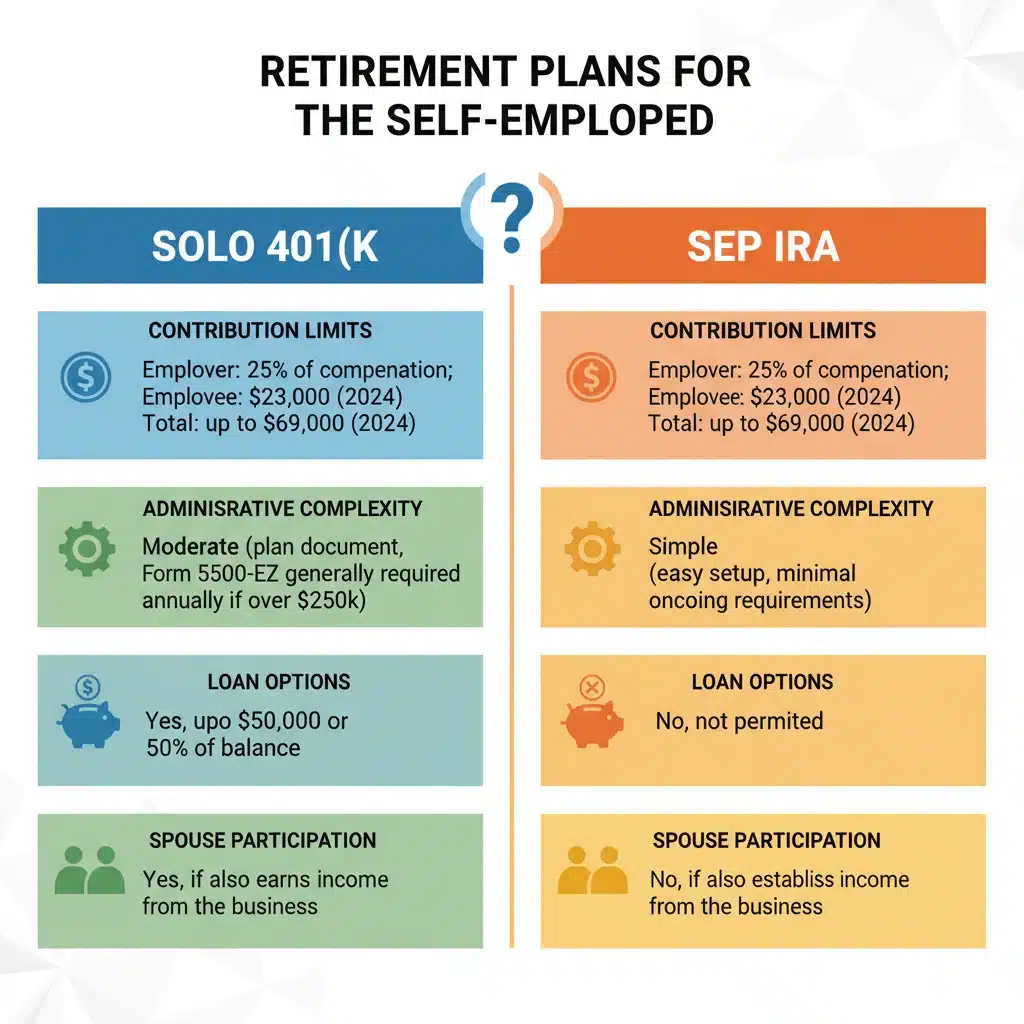
Solo 401(k) vs. SEP IRA: Which is Right for Your Self-Employed Retirement in 2026?
Choosing between a Solo 401(k) and a SEP IRA for self-employed retirement 2026 depends largely on your specific circumstances, particularly your income level, whether you have employees, and your desire for administrative simplicity versus maximum contribution potential.
When to Choose a Solo 401(k):
- You want to maximize contributions: If your income is high enough to allow you to contribute both the employee and employer portions, the Solo 401(k) often allows for higher total contributions than a SEP IRA.
- You want a Roth option: If you believe you’ll be in a higher tax bracket in retirement or want to diversify your tax exposure, the Roth Solo 401(k) is a significant advantage.
- You want the ability to take a loan: While not always recommended, the loan feature can be a safety net.
- You have no full-time employees (other than a spouse): This is the primary eligibility requirement.
- You want to include your spouse: If your spouse also works for your business, they can participate and make their own contributions, significantly boosting household savings.
When to Choose a SEP IRA:
- You prioritize simplicity: The SEP IRA is generally easier to set up and administer with minimal paperwork.
- You have employees: If you have employees and still want a high-contribution plan, a SEP IRA might be more feasible than a Solo 401(k), although you must contribute for your employees.
- Your business income fluctuates: The flexibility to contribute nothing in a lean year without penalty can be beneficial.
- You have very high income: In some very high-income scenarios, the 25% of compensation rule for SEP IRAs might allow for slightly higher employer-only contributions than the employer portion of a Solo 401(k), but this is less common when considering the total Solo 401(k) contribution.
Hybrid Scenarios and Key Considerations for 2026
It’s also worth noting that you can have both a SEP IRA and a Solo 401(k) in certain rare situations, though this is usually unnecessary and adds complexity. Most self-employed individuals will find one of these options sufficient.
Regardless of your choice, remember to consider the following for your self-employed retirement 2026 strategy:
- Your Income Level: Higher income generally means you can take greater advantage of the higher contribution limits.
- Your Age: If you’re 50 or older, the catch-up contributions for a Solo 401(k) can be a significant boost.
- Future Business Growth: If you anticipate hiring employees in the future, consider how each plan might need to adapt.
- Tax Strategy: Do you prefer tax-deferred growth (SEP IRA, traditional Solo 401(k)) or tax-free withdrawals in retirement (Roth Solo 401(k))?
- Investment Options: Both plans typically offer a wide range of investment options, but confirm with your chosen custodian.
Setting Up Your Self-Employed Retirement Plan for 2026
Once you’ve decided between a Solo 401(k) and a SEP IRA, the next step is to set up your plan. The process is generally straightforward, but attention to detail is important.
For a Solo 401(k):
You’ll typically need to open two accounts: a trust account for the 401(k) plan itself and a brokerage account within that trust to hold your investments. Many financial institutions, including major brokerage firms, offer Solo 401(k) plans. You will need to complete adoption agreements and plan documents. It’s often recommended to work with a provider that specializes in these plans to ensure compliance.
For a SEP IRA:
Setting up a SEP IRA is much simpler. You can open one at almost any financial institution that offers IRAs, such as a bank, mutual fund company, or brokerage firm. You’ll typically complete a simple application form and, in most cases, an IRS Form 5305-SEP, which is a model SEP plan document.
Regardless of the plan you choose, ensure you understand the deadlines for contributions. For both plans, contributions for a given tax year can generally be made up until the tax filing deadline of your business (including extensions). This flexibility can be beneficial for cash flow management throughout the year.
Maximizing Your Contributions and Investment Strategy
Simply opening an account is only the first step. To truly secure your self-employed retirement 2026, you need a robust contribution and investment strategy.
Contribution Strategies:
- Automate Savings: Set up automatic transfers from your business checking account to your retirement account. This ensures consistent contributions and prevents you from forgetting.
- Pay Yourself First: Treat your retirement contribution as a mandatory business expense. Dedicate a percentage of every payment you receive to your retirement fund.
- Review Annually: Re-evaluate your contribution limits and your ability to contribute each year, especially as your income grows.
Investment Strategies:
- Diversification: Spread your investments across different asset classes (stocks, bonds, real estate, etc.) to mitigate risk.
- Asset Allocation: Your ideal asset allocation will depend on your age, risk tolerance, and time horizon until retirement. Younger individuals can typically afford to take on more risk.
- Low-Cost Index Funds/ETFs: These are often recommended for long-term investors due to their low fees and broad market exposure.
- Rebalancing: Periodically adjust your portfolio back to your target asset allocation to maintain your desired risk level.
Consider consulting with a financial advisor who specializes in self-employed financial planning. They can help you navigate complex investment decisions and ensure your strategy aligns with your unique business and personal financial goals.

Tax Implications and Reporting for Self-Employed Retirement Plans
Understanding the tax implications of your chosen retirement plan is just as important as maximizing contributions. Both Solo 401(k)s and SEP IRAs offer significant tax advantages, primarily tax-deferred growth.
Tax-Deferred Growth:
Contributions to traditional Solo 401(k)s and SEP IRAs are typically tax-deductible in the year they are made, reducing your current taxable income. The investments within these accounts grow tax-free until withdrawal in retirement, at which point they are taxed as ordinary income.
Roth Solo 401(k):
If you choose the Roth option within your Solo 401(k), your contributions are made with after-tax dollars, meaning they are not tax-deductible in the current year. However, qualified withdrawals in retirement are completely tax-free, including all earnings. This can be a powerful strategy if you anticipate being in a higher tax bracket in retirement than you are now.
Reporting Requirements:
- SEP IRA: Generally, there are no specific annual IRS filing requirements for a SEP IRA beyond reporting your contributions on your personal tax return (Schedule C for sole proprietors, or other business tax forms).
- Solo 401(k): If your Solo 401(k) plan’s assets exceed $250,000 at the end of a plan year, you are required to file IRS Form 5500-EZ. This form provides information about the plan’s financial condition and operations. While it might seem complex, many Solo 401(k) providers offer assistance or tools to help with this filing.
Always keep meticulous records of your contributions and any distributions. Consulting with a tax professional who understands self-employed tax strategies is highly recommended to ensure compliance and optimize your tax situation.
Looking Ahead: Future Trends and Regulatory Changes for 2026
The world of retirement planning is subject to legislative and economic changes. While we are planning for self-employed retirement 2026, it’s essential to remain adaptable.
Legislation like the SECURE Act and SECURE Act 2.0 has already brought significant changes to retirement planning, such as increasing the age for required minimum distributions (RMDs) and expanding Roth options. It’s possible that further legislation could impact contribution limits, catch-up contributions, or the rules surrounding these plans.
Economic factors, such as inflation rates and market performance, will also influence the projected contribution limits and the overall growth of your retirement savings. Staying informed through reputable financial news sources and your financial advisor is key to adapting your strategy as needed.
For self-employed individuals, there’s a growing emphasis on financial literacy and proactive planning. The gig economy continues to expand, bringing more people into the ranks of the self-employed. This trend may lead to further innovations or simplifications in retirement plan offerings tailored to this demographic.
Conclusion: Securing Your Self-Employed Retirement in 2026
As a self-employed individual, taking charge of your retirement planning is one of the most critical financial decisions you will make. The Solo 401(k) and SEP IRA both offer powerful avenues to build substantial retirement wealth, each with its own set of advantages and considerations.
For self-employed retirement 2026, the choice often boils down to whether you prioritize maximum contribution potential with a Roth option and loan features (Solo 401(k)) or administrative simplicity and high employer contributions (SEP IRA). If you have no employees, the Solo 401(k) often provides more flexibility and higher overall contribution limits.
Start early, contribute consistently, and review your plan regularly. Don’t underestimate the power of compound interest over time. By understanding these powerful retirement vehicles and aligning them with your personal and business goals, you can build a secure and prosperous future for yourself, free from the financial worries that can plague those who fail to plan.
Remember, your journey as a self-employed individual is about building a legacy, and that includes your financial well-being in retirement. Make 2026 the year you solidify your commitment to a robust and fulfilling retirement.