Robo-Advisors 2026: Performance, Fees & Future Trends

Evaluating Robo-Advisors for Your 2026 Investment Strategy: A Performance Comparison
In the rapidly evolving landscape of personal finance, automated investment platforms, commonly known as robo-advisors, have transitioned from niche offerings to mainstream staples. As we look towards 2026, understanding the nuances of these digital wealth managers becomes paramount for any savvy investor. This comprehensive guide aims to provide an in-depth Robo-Advisors 2026 Comparison, delving into their performance, fee structures, technological advancements, and overall suitability for your financial goals.
The appeal of robo-advisors lies in their ability to offer sophisticated portfolio management at a fraction of the cost of traditional financial advisors. By leveraging algorithms and advanced computational power, they can construct, rebalance, and optimize investment portfolios tailored to individual risk tolerances and objectives. However, with an increasing number of players in the market, discerning the best fit requires careful evaluation. This article will equip you with the knowledge to make informed decisions about integrating robo-advisors into your 2026 investment strategy.
The Rise of Automated Investing: A Look Back and Forward
The concept of automated investing isn’t new, but its widespread adoption and sophistication have grown exponentially over the last decade. Initially, robo-advisors primarily focused on passive index investing, offering low-cost access to diversified portfolios. Fast forward to 2026, and the industry has matured significantly, incorporating more advanced features such as tax-loss harvesting, goal-based planning, and even access to human financial advisors. The initial skepticism surrounding these platforms has largely dissipated, replaced by a recognition of their efficiency and accessibility.
For investors navigating the complexities of modern markets, the value proposition of robo-advisors is clear: professional-grade investment management without the prohibitive costs. This democratized access to financial advice has empowered millions to take control of their financial futures. Our Robo-Advisors 2026 Comparison will highlight how these platforms are adapting to new market conditions and evolving investor demands, ensuring you stay ahead of the curve.
Key Metrics for Evaluating Robo-Advisors in 2026
When assessing robo-advisors, several critical factors come into play. It’s not just about who offers the lowest fees or the highest returns; a holistic view is essential. Here’s what we’ll be examining in our detailed Robo-Advisors 2026 Comparison:
- Performance: While past performance is not indicative of future results, understanding how different robo-advisors have performed across various market cycles can offer valuable insights. We’ll look at risk-adjusted returns and consistency.
- Fees: Management fees are a primary consideration. Robo-advisors typically charge a percentage of assets under management (AUM), which can range from 0.15% to 0.50% or more. We’ll also consider underlying ETF expense ratios.
- Investment Philosophy and Asset Allocation: Do they favor passive index investing, or do they incorporate active strategies? How diversified are their portfolios? Understanding their approach is crucial for alignment with your own beliefs.
- Features and Services: Beyond basic portfolio management, what additional services do they offer? This could include tax-loss harvesting, goal-based planning, financial planning tools, banking services, and access to human advisors.
- User Experience and Customer Support: An intuitive interface and responsive customer support can significantly enhance your investing journey.
- Minimum Investment Requirements: Some platforms cater to beginners with low minimums, while others require substantial initial deposits.
Top Robo-Advisors for 2026: An In-Depth Comparison
Let’s dive into a detailed examination of some of the leading robo-advisor platforms expected to dominate the market in 2026. This section will form the core of our Robo-Advisors 2026 Comparison, providing actionable insights for your investment decisions.
Wealthfront: Sophistication Meets Automation
Wealthfront has consistently been a leader in the robo-advisor space, known for its sophisticated algorithms and comprehensive features. In 2026, it continues to offer a compelling package for growth-oriented investors.
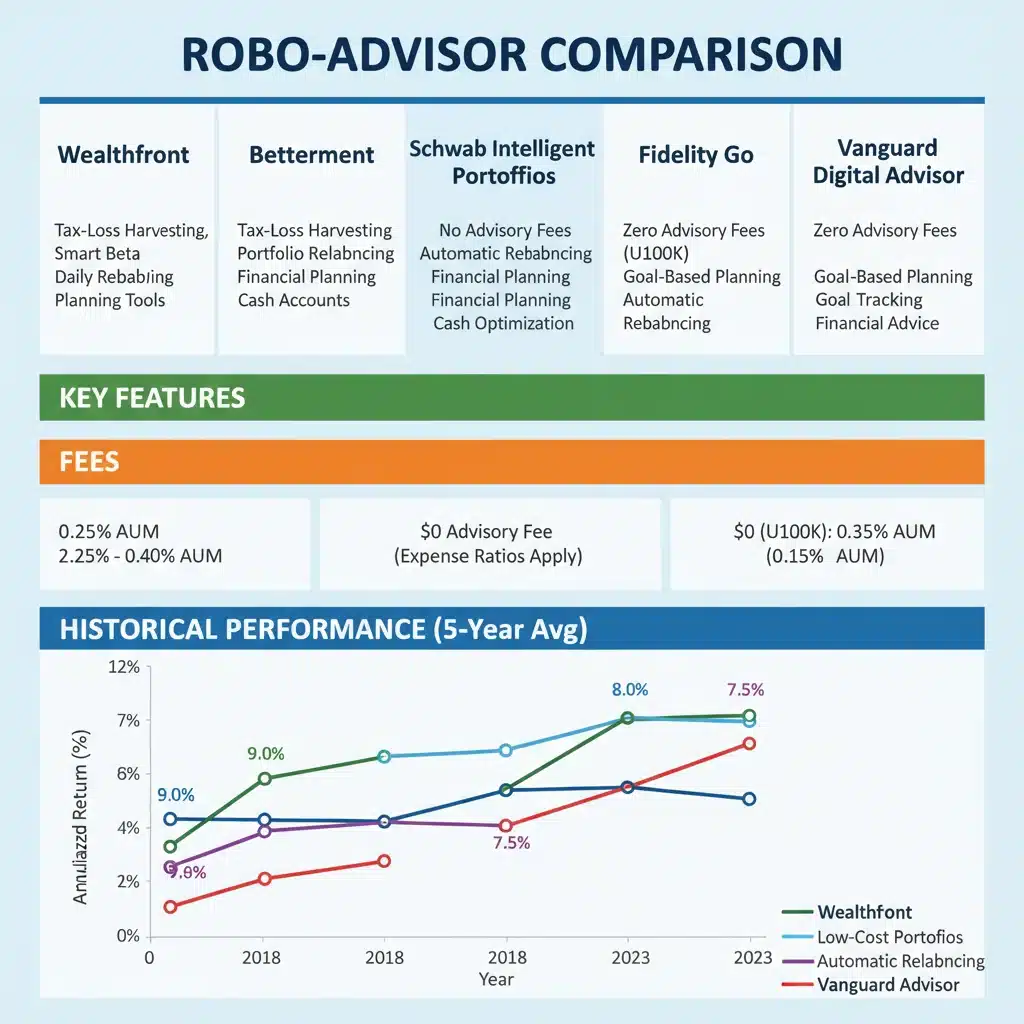
- Performance: Wealthfront’s portfolios are designed for long-term growth, primarily utilizing passively managed ETFs across various asset classes. Their commitment to tax-loss harvesting across all taxable accounts is a significant differentiator, potentially boosting after-tax returns. Historical data suggests competitive performance, especially for those who fully utilize their tax-optimization strategies.
- Fees: Wealthfront charges a straightforward 0.25% annual advisory fee on AUM. This competitive fee structure, combined with low-cost ETFs, makes it an attractive option for cost-conscious investors seeking advanced features.
- Investment Philosophy: Wealthfront adheres to a modern portfolio theory (MPT) approach, building globally diversified portfolios based on your risk tolerance. They offer a wide range of asset classes, including US stocks, international stocks, emerging markets, real estate, natural resources, and various types of bonds.
- Key Features for 2026:
- Automated Tax-Loss Harvesting: One of the most robust offerings in the industry, designed to reduce your tax bill.
- Smart Beta Portfolios: For those seeking more advanced strategies, Wealthfront offers Smart Beta, which aims to outperform market-cap-weighted indices.
- Portfolio Line of Credit: Access liquidity without selling your investments.
- Path: A comprehensive financial planning tool that helps project future financial scenarios, including retirement and major purchases.
- Cash Account: High-yield cash accounts integrated with investment services.
- Minimum Investment: $500 to open an investment account.
Wealthfront remains a strong contender in our Robo-Advisors 2026 Comparison, particularly for investors who value tax efficiency and advanced portfolio customization.
Betterment: Goal-Oriented and User-Friendly
Betterment pioneered many of the features now common among robo-advisors, focusing on goal-based investing and an incredibly user-friendly experience. For 2026, it continues to refine its offerings, making it accessible to a broad range of investors.
- Performance: Betterment’s portfolios are constructed with a focus on long-term growth and risk management. They use a diversified mix of ETFs, carefully selected to align with various risk levels. Their performance is generally in line with market benchmarks for similar risk profiles, with tax-loss harvesting adding value for taxable accounts.
- Fees: Betterment offers two main tiers:
- Digital: 0.25% annual advisory fee for balances up to $100,000.
- Premium: 0.40% annual advisory fee for balances over $100,000, which includes unlimited phone access to certified financial planners.
- Investment Philosophy: Betterment employs a modern portfolio theory approach, building diversified portfolios of low-cost ETFs. They offer several portfolio options, including a core portfolio, socially responsible investing (SRI), and income-focused portfolios.
- Key Features for 2026:
- Goal-Based Investing: Easily set up and track progress towards multiple financial goals (e.g., retirement, down payment).
- Automated Tax-Loss Harvesting: Available for taxable accounts, helping to reduce tax liabilities.
- Tax-Coordinated Portfolios: Strategically places different asset types in specific account types (taxable vs. tax-advantaged) to maximize after-tax returns.
- Flexible Portfolios: Allows some customization of asset allocations.
- Human Advisor Access: Premium plan offers unlimited calls with financial experts.
- Minimum Investment: $0 to open an account, but a $10 minimum deposit to start investing.
Betterment’s emphasis on goal-oriented planning and accessible human advice makes it a strong contender in our Robo-Advisors 2026 Comparison for both new and experienced investors.
Fidelity Go: A Trusted Name in Automated Investing
Fidelity, a long-standing giant in the financial industry, offers Fidelity Go as its entry into the robo-advisor market. Combining the reliability of a traditional brokerage with automated investing, it presents a compelling option for many.
- Performance: Fidelity Go constructs portfolios using a mix of Fidelity Flex mutual funds, which have zero expense ratios. This unique approach means investors only pay the advisory fee, potentially leading to higher net returns compared to platforms using ETFs with separate expense ratios. Performance is generally solid, aligning with diversified market returns.
- Fees:
- Balances under $25,000: No advisory fee.
- Balances over $25,000: 0.35% annual advisory fee.
- Investment Philosophy: Fidelity Go builds diversified portfolios based on your risk tolerance, utilizing a selection of Fidelity Flex mutual funds. These funds cover various asset classes, including U.S. stocks, international stocks, and bonds.
- Key Features for 2026:
- Zero Expense Ratio Funds: A major advantage, as the underlying investments have no additional fees.
- Automatic Rebalancing: Ensures your portfolio stays aligned with your target allocation.
- Access to Fidelity’s Ecosystem: Seamless integration with other Fidelity products and services, including their robust research tools and customer support.
- Human Advisor Access: While not a core feature of Fidelity Go, clients can easily transition to or complement their automated investing with Fidelity’s broader suite of advisory services.
- Minimum Investment: $0 to open, $0 for advisory fees under $25,000.
Fidelity Go stands out in our Robo-Advisors 2026 Comparison for its fee structure for smaller balances and the backing of a well-established financial institution, making it ideal for beginners or those already with Fidelity.
Schwab Intelligent Portfolios: Commission-Free Investing
Charles Schwab’s Intelligent Portfolios offers a unique value proposition: commission-free automated investing. This means no advisory fees, although investors still incur expense ratios from the underlying ETFs.
- Performance: Schwab Intelligent Portfolios build diversified portfolios using a broad range of Schwab ETFs and third-party ETFs. Performance is generally competitive, tracking market benchmarks for similar risk profiles. The absence of an advisory fee can significantly boost net returns over the long term, especially for larger balances.
- Fees: $0 advisory fee. Investors only pay the expense ratios of the underlying ETFs, which are typically low.
- Investment Philosophy: Schwab employs a diversified asset allocation strategy across up to 20 asset classes, including U.S. stocks, international stocks, developed and emerging markets, various bond types, and even gold and real estate.
- Key Features for 2026:
- No Advisory Fee: A major draw, making it highly cost-effective.
- Automated Rebalancing and Tax-Loss Harvesting: Standard features for optimizing portfolios and reducing taxes.
- Diversified Portfolios: Broad exposure across many asset classes.
- Access to Human Advisors (Premium): For a flat monthly fee ($30/month after a $300 one-time planning fee), users can access certified financial planners.
- Cash Allocation: A notable feature (or point of contention for some) is the significant cash allocation in portfolios, which can range from 6% to 29%, providing stability but potentially impacting returns during bull markets.
- Minimum Investment: $5,000 for the basic service, $25,000 for Schwab Intelligent Portfolios Premium.
Schwab Intelligent Portfolios offers an incredibly low-cost option in our Robo-Advisors 2026 Comparison, particularly appealing to investors who prioritize minimizing advisory fees and have a higher initial capital.
Vanguard Digital Advisor: Low-Cost Index Investing Powerhouse
Vanguard, renowned for its low-cost index funds, brings its philosophy to the robo-advisor space with Vanguard Digital Advisor. It’s an excellent choice for investors who believe in broad market exposure and minimal fees.
- Performance: Vanguard Digital Advisor constructs portfolios exclusively with Vanguard ETFs, known for their ultra-low expense ratios. The performance is directly tied to the underlying market performance of these highly diversified index funds. It’s designed for consistent, long-term returns in line with broad market movements.
- Fees: 0.15% annual advisory fee on managed assets. This is one of the lowest advisory fees in the industry. Combined with Vanguard’s already low ETF expense ratios, the total cost of ownership is exceptionally competitive.
- Investment Philosophy: Pure passive index investing. Vanguard Digital Advisor builds globally diversified portfolios of Vanguard ETFs based on your risk profile and financial goals.
- Key Features for 2026:
- Extremely Low Fees: Unbeatable total cost for automated advice.
- Vanguard’s Reputation: Backed by a company synonymous with low-cost, investor-first principles.
- Goal-Based Planning: Helps users plan for various financial goals like retirement and general savings.
- Automatic Rebalancing: Ensures portfolio stays on track.
- No Tax-Loss Harvesting: A notable absence compared to competitors, which might be a consideration for those in higher tax brackets with taxable accounts.
- Minimum Investment: $3,000 to open an account.
For investors deeply committed to low-cost, passive index investing, Vanguard Digital Advisor is a top choice in our Robo-Advisors 2026 Comparison, offering unparalleled value in terms of fees.
Future Trends in Robo-Advisory for 2026 and Beyond
The robo-advisor landscape is dynamic, constantly evolving with technological advancements and shifting investor needs. Here’s what we anticipate for 2026 and the coming years:
Enhanced Personalization and Customization
While current robo-advisors offer personalized portfolios based on risk tolerance, 2026 will see even greater customization. This includes more nuanced asset allocations, deeper integration of individual values (e.g., advanced SRI/ESG options), and the ability to incorporate specific holdings or restrictions based on an investor’s preferences or existing assets. The Robo-Advisors 2026 Comparison reveals a clear trend towards tailoring advice beyond basic algorithms.
Hybrid Models: The Best of Both Worlds
The distinction between purely automated and human-advised platforms is blurring. Hybrid models, offering automated investment management complemented by access to human financial planners, will become the norm. This allows investors to enjoy the efficiency and cost-effectiveness of automation while still having the option for personalized guidance on complex financial planning matters like estate planning or intricate tax strategies. Many platforms in our Robo-Advisors 2026 Comparison already offer this, and it will only expand.
Integration with Broader Financial Ecosystems
Robo-advisors will increasingly integrate with other financial services, creating seamless, all-in-one financial management platforms. This could include banking, budgeting tools, credit score monitoring, and even insurance services. The goal is to provide a holistic view of an individual’s financial life, allowing for more comprehensive and optimized advice.
Leveraging AI and Machine Learning for Predictive Analytics
The core of robo-advisors is algorithms, but the next generation will heavily utilize advanced AI and machine learning. This will enable more sophisticated predictive analytics, potentially identifying market anomalies, optimizing rebalancing strategies in real-time, and offering proactive, hyper-personalized financial advice based on life events and behavioral patterns. This evolution will significantly impact the Robo-Advisors 2026 Comparison in terms of intelligent features.
Focus on Behavioral Finance
Understanding and mitigating behavioral biases that often lead to poor investment decisions will be a growing area of focus. Robo-advisors will incorporate nudges and features designed to help investors stick to their plans, avoid emotional reactions to market volatility, and make more rational financial choices. This human-centric design, powered by technology, will be a key differentiator.

Choosing the Right Robo-Advisor for You in 2026
With so many excellent options available, selecting the right robo-advisor depends largely on your individual circumstances, financial goals, and preferences. Here’s a framework to help you decide after reviewing our Robo-Advisors 2026 Comparison:
- For the Cost-Conscious Investor: If minimizing fees is your top priority, Schwab Intelligent Portfolios (for no advisory fee) or Vanguard Digital Advisor (for the lowest advisory fee) are strong contenders. Just remember to factor in underlying ETF expense ratios.
- For the Tax-Savvy Investor: Wealthfront and Betterment excel in automated tax-loss harvesting and tax-optimized portfolio strategies, which can be highly beneficial for taxable accounts.
- For Beginners and Those with Lower Balances: Fidelity Go offers advisory-fee-free investing up to $25,000, making it very accessible. Betterment also has a low minimum to start.
- For Those Seeking Human Guidance: Betterment Premium and Schwab Intelligent Portfolios Premium offer access to human financial planners, providing a valuable blend of automation and personalized advice.
- For Advanced Features and Customization: Wealthfront’s Smart Beta and comprehensive financial planning tools might appeal to more experienced investors looking for deeper portfolio sophistication.
- For Goal-Oriented Planning: Betterment’s intuitive goal-setting features make it easy to visualize and work towards multiple financial objectives.
Consider your personal financial situation, including your investment horizon, risk tolerance, whether you need taxable or tax-advantaged accounts, and your comfort level with technology versus human interaction. Don’t hesitate to open accounts with a few different platforms and explore their interfaces before committing a significant amount of capital. Many offer virtual tours or low minimums to get started.
The Synergy of Robo-Advisors and Traditional Investing
It’s important to note that choosing a robo-advisor doesn’t necessarily mean abandoning traditional investing methods entirely. For many, a balanced approach works best. Robo-advisors can efficiently manage a core portfolio for long-term goals, while a portion of your investments might be self-directed for specific stocks or thematic ETFs. This hybrid approach allows investors to leverage the strengths of both worlds.
Furthermore, traditional financial advisors are increasingly incorporating robo-advisor technology into their practices, using these tools to manage smaller accounts or automate routine tasks, freeing them up to focus on more complex client needs. This convergence suggests a future where automated and human advice work in tandem, rather than being mutually exclusive.
Conclusion: Empowering Your 2026 Investment Strategy
The Robo-Advisors 2026 Comparison demonstrates that these platforms are no longer just a trend; they are a fundamental component of modern investment management. They offer unparalleled accessibility, cost-effectiveness, and sophistication, making professional-grade investing available to a wider audience than ever before.
Whether you’re a seasoned investor looking for tax-efficient strategies or a beginner taking your first steps, there’s a robo-advisor out there to meet your needs. By carefully evaluating performance, fees, features, and your personal financial situation, you can harness the power of automated investing to achieve your financial goals in 2026 and beyond. The future of finance is here, and it’s smarter, more accessible, and more personalized than ever.
Remember to regularly review your portfolio and financial plan, making adjustments as your life circumstances or market conditions change. The best robo-advisor is the one that aligns most closely with your objectives and helps you stay disciplined on your path to financial success.