Debt Management in 2026: 6-Month Plan to Boost Your Credit
This article outlines a pragmatic 6-month plan for effective debt management in 2026, focusing on systematically reducing high-interest debt and improving your credit score by a significant 50 points, offering clear steps to financial stability.
Embarking on a journey towards financial freedom in 2026 requires a strategic approach, especially when dealing with high-interest obligations. This comprehensive guide outlines a powerful Debt Management in 2026: A 6-Month Plan to Systematically Reduce High-Interest Debt and Improve Your Credit Score by 50 Points, designed to help you regain control and build a stronger financial future.
Understanding Your Current Financial Landscape
Before any effective debt management strategy can be implemented, a clear and honest assessment of your current financial situation is paramount. This initial step involves gathering all relevant financial documents and meticulously detailing your income, expenses, and all outstanding debts. Many people underestimate the importance of this stage, but it provides the foundational data needed to make informed decisions.
It’s not just about knowing how much you owe, but understanding to whom, at what interest rate, and with what minimum monthly payment. This granular detail allows for a precise identification of high-interest debts that should be prioritized for accelerated repayment. Ignoring this phase can lead to a less effective plan, or worse, perpetuate a cycle of debt.
Collecting Financial Data
- Income Sources: List all regular income, including salary, freelance work, and any passive income streams.
- Monthly Expenses: Categorize all spending, from fixed costs like rent/mortgage to variable expenses like groceries and entertainment.
- Debt Inventory: Compile a list of all debts, noting the creditor, current balance, interest rate, minimum payment, and due date.
Understanding your cash flow is crucial. By meticulously tracking where every dollar comes from and goes, you can identify areas for potential savings and reallocate those funds towards debt reduction. This foundational work sets the stage for a successful 6-month debt management plan.
Crafting Your Personalized Budget for Debt Reduction
With a clear understanding of your financial landscape, the next critical step in effective Debt Management in 2026 is to create a realistic and actionable budget. A budget isn’t about restriction; it’s about empowerment, giving you control over your money and directing it towards your financial goals, specifically debt reduction and credit score improvement. This step will help you identify surplus funds that can be strategically applied to high-interest debts.
The key to a successful budget is its realism. An overly restrictive budget is often abandoned, leading to frustration and a return to old habits. Instead, aim for a balanced approach that allows for necessary expenses and some discretionary spending, while still aggressively tackling debt. This involves distinguishing between needs and wants, and making conscious choices about where your money goes.
Implementing the Zero-Based Budgeting Method
The zero-based budgeting method ensures every dollar has a job, leaving no room for guesswork. This approach requires you to allocate every dollar of your income to either an expense, savings, or debt repayment.
- Allocate Every Dollar: Assign a purpose to every dollar of your income until your income minus your expenses, savings, and debt payments equals zero.
- Prioritize Debt Payments: After covering essential expenses, reallocate funds from non-essential categories directly to your highest-interest debts.
- Regular Review: Budgets are not static; review and adjust yours weekly or bi-weekly to reflect changing circumstances and spending patterns.
By diligently following a personalized budget, you transform your financial intentions into concrete actions. This disciplined approach is fundamental to freeing up extra cash, which is the fuel for accelerating your debt reduction journey and consequently improving your credit score.
Strategic Debt Repayment Methods: Avalanche vs. Snowball
Once your budget is established and you’ve identified additional funds for debt repayment, the next strategic decision in your Debt Management in 2026 plan is choosing the most effective repayment method. The two most popular and proven strategies are the debt avalanche and the debt snowball. Both aim to systematically reduce your debt, but they differ in their approach and psychological impact. Understanding each method will help you determine which aligns best with your financial personality and goals.
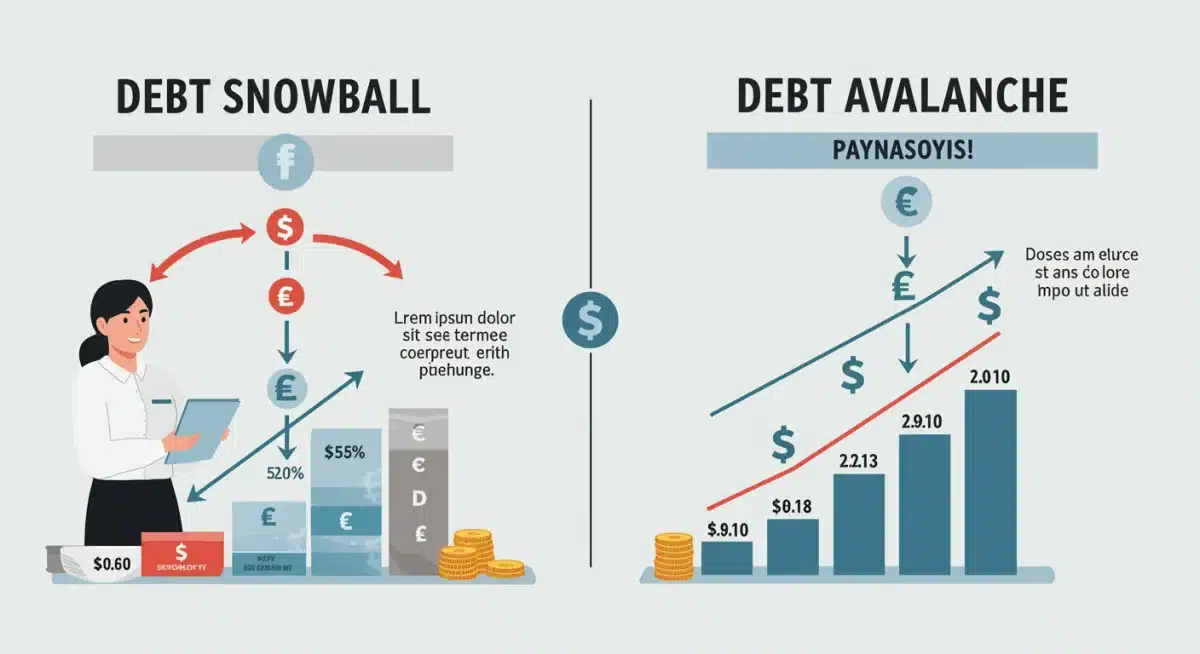
The choice between these methods often comes down to a balance between mathematical efficiency and psychological motivation. The debt avalanche saves you more money in interest over time, while the debt snowball provides quicker wins that can keep you motivated throughout the process. Consider your own discipline and what will keep you committed to the plan for the full six months and beyond.
Debt Avalanche Method
The debt avalanche method prioritizes debts with the highest interest rates first. You make minimum payments on all debts except for the one with the highest interest rate, on which you pay as much as possible. Once that debt is paid off, you take the money you were paying on it and add it to the payment of the next highest interest rate debt. This method saves you the most money in interest over the long term.
This strategy is mathematically superior, as it minimizes the total interest paid, leading to faster overall debt elimination. It requires a degree of discipline and patience, as initial progress might feel slower compared to the snowball method, especially if your highest-interest debt has a large balance.
Debt Snowball Method
The debt snowball method focuses on paying off the smallest debt first, regardless of its interest rate. You make minimum payments on all debts except for the smallest one, on which you pay as much as possible. Once that debt is paid off, you take the money you were paying on it and add it to the payment of the next smallest debt. This continues until all debts are paid.
- Psychological Boost: Paying off smaller debts quickly provides psychological wins, building momentum and motivation to continue.
- Faster Initial Progress: You see debts disappear faster, which can be crucial for maintaining commitment to the plan.
- Less Interest Savings: While motivating, this method typically results in paying more interest overall compared to the avalanche method.
Both methods are effective for debt reduction, but the avalanche method is more financially efficient, while the snowball method offers greater psychological reinforcement. Choose the one that best suits your individual motivation and financial situation to ensure consistent progress in your 6-month plan.
Leveraging Credit and Debt Consolidation in 2026
As you progress through your Debt Management in 2026 plan, exploring options for optimizing your existing credit and potentially consolidating debt can significantly accelerate your progress. Debt consolidation isn’t a magic bullet, but when used wisely, it can streamline payments, reduce interest rates, and simplify your financial life. It’s crucial to approach these options with caution and a clear understanding of their implications for your credit score and overall debt load.
In 2026, new financial products and services might offer even more tailored solutions for consolidation. Always research thoroughly and compare offers from reputable lenders. The goal is to lower your effective interest rate and make your debt more manageable, not to incur new debt or extend your repayment period unnecessarily. This step requires careful consideration and often involves a temporary dip in your credit score, which will recover as you consistently make payments.
Debt Consolidation Loans
A debt consolidation loan combines multiple debts into a single loan, ideally with a lower interest rate. This can simplify your payments and potentially reduce your monthly outlay. However, it’s essential to ensure the new loan’s interest rate is significantly lower than your current average, and that you do not extend the repayment term beyond what is financially prudent.
- Lower Interest Rates: Seek out loans with rates substantially below your current high-interest debts.
- Single Monthly Payment: Simplifies budgeting and reduces the risk of missed payments.
- Credit Score Impact: Initial hard inquiry and new account opening may temporarily lower your score, but consistent payments will rebuild it.
Balance Transfer Credit Cards
Balance transfer credit cards allow you to move high-interest credit card debt to a new card, often with a 0% introductory APR for a promotional period. This can be an excellent strategy if you can pay off the transferred balance within the introductory period, saving you a significant amount in interest.
However, be mindful of balance transfer fees, which typically range from 3% to 5% of the transferred amount. Also, ensure you can pay off the balance before the promotional period ends and the regular, often high, APR kicks in. This strategy requires discipline to avoid accumulating new debt on the old cards or the new one.
Carefully evaluating these options and choosing the one that best fits your situation can be a game-changer for your 6-month debt reduction and credit score improvement plan. Always read the fine print and understand all terms and conditions before committing.
Monitoring Progress and Adapting Your Plan
The journey of Debt Management in 2026 is not a static one; it requires continuous monitoring and adaptation. Over a 6-month period, financial circumstances can change, and your initial plan might need adjustments. Regularly tracking your progress not only keeps you accountable but also provides valuable insights into what’s working and what needs tweaking. This proactive approach ensures you stay on track towards your goal of reducing high-interest debt and boosting your credit score by 50 points.
It’s vital to celebrate small victories along the way. Paying off a credit card, reaching a certain debt reduction milestone, or seeing your credit score incrementally increase can provide the motivation needed to continue. Don’t be discouraged by minor setbacks; instead, view them as learning opportunities to refine your strategy.
Tools for Tracking and Analysis
Utilize financial tracking apps or spreadsheets to keep a close eye on your income, expenses, and debt balances. Many platforms offer features to visualize your progress, which can be incredibly motivating.
- Budgeting Apps: Tools like Mint, YNAB (You Need A Budget), or Personal Capital can automate tracking and categorize spending.
- Credit Monitoring Services: Services like Credit Karma, Experian, or FICO offer regular updates on your credit score and reports, highlighting areas for improvement.
- Regular Review Meetings: Schedule weekly or bi-weekly check-ins with yourself (or a partner) to review your budget and debt repayment progress.
Adapting your plan means being flexible. If an unexpected expense arises, don’t abandon your budget entirely. Instead, adjust your spending in other areas or temporarily reallocate funds. The goal is consistent, albeit sometimes modified, effort towards your financial objectives.
Sustaining Financial Health Beyond 6 Months
Achieving your 6-month goal of reducing high-interest debt and improving your credit score by 50 points is a significant accomplishment, but Debt Management in 2026 extends beyond this initial period. True financial freedom and stability come from establishing sustainable habits and long-term strategies. This final phase focuses on maintaining your progress, building a robust financial safety net, and continuing to monitor your credit health to ensure lasting success.
The habits you’ve built over the past six months—diligent budgeting, strategic debt repayment, and conscious spending—are your most valuable assets. Continue to practice them, even after your immediate debt goals are met. The objective shifts from aggressive debt reduction to wealth accumulation and financial resilience.
Building an Emergency Fund
One of the most crucial elements of long-term financial health is a fully funded emergency fund. This fund should ideally cover 3-6 months of essential living expenses, providing a buffer against unexpected job loss, medical emergencies, or unforeseen repairs, preventing you from falling back into debt.
- Automate Savings: Set up automatic transfers from your checking to a separate savings account each payday.
- Prioritize Funding: Treat your emergency fund savings as a non-negotiable expense in your budget.
- Review and Replenish: If you use funds from your emergency savings, make it a priority to replenish it as quickly as possible.
Continuous Credit Monitoring and Smart Borrowing
Even with a good credit score, vigilance is key. Regularly review your credit reports for errors or fraudulent activity. When considering new credit, always assess if it aligns with your long-term financial goals and if you can comfortably manage the payments without compromising your financial stability.
By integrating these practices into your financial routine, you are not just managing debt; you are cultivating a lifestyle of financial prudence and empowerment that will serve you well for years to come. This enduring commitment ensures that your efforts in the 6-month plan yield lasting benefits.
| Key Step | Brief Description |
|---|---|
| Financial Assessment | Detail all income, expenses, and debts to understand your current financial standing. |
| Budget Creation | Craft a realistic budget to free up funds for accelerated debt repayment. |
| Repayment Strategy | Choose between the debt avalanche or snowball method for systematic debt reduction. |
| Monitor & Adapt | Regularly track progress and adjust your plan as financial circumstances evolve. |
Frequently Asked Questions About Debt Management in 2026
The main goal is to systematically reduce high-interest debt and improve your credit score by 50 points within six months. It provides a structured approach to regain financial control and establish healthier money habits for the long term.
The debt avalanche targets debts with the highest interest rates first, saving more money on interest. The debt snowball focuses on paying off the smallest debts first, providing psychological motivation through quick wins, though it may cost more in interest.
Initially, a debt consolidation loan or balance transfer may cause a temporary dip due to a hard inquiry and new account opening. However, consistent and timely payments on the consolidated debt will help rebuild and improve your credit score over time.
Budgeting is fundamental. It helps you understand your cash flow, identify unnecessary expenses, and reallocate funds specifically for accelerated debt repayment. A realistic and regularly reviewed budget is crucial for freeing up money to tackle high-interest debts.
Sustaining financial health involves building an emergency fund covering 3-6 months of expenses, continuing smart budgeting practices, and regularly monitoring your credit. These habits prevent future debt accumulation and build lasting financial resilience.
Conclusion
Successfully navigating Debt Management in 2026: A 6-Month Plan to Systematically Reduce High-Interest Debt and Improve Your Credit Score by 50 Points is an achievable goal with the right strategy and commitment. By diligently assessing your finances, creating a realistic budget, choosing an effective repayment method, and strategically leveraging consolidation options, you can transform your financial outlook. Remember, this 6-month plan is not just about debt reduction; it’s about building sustainable financial habits that will empower you for years to come, leading to greater financial freedom and a significantly improved credit profile.