College Savings 2025: 529 Plans vs. UGMA/UTMA for US Families

Navigating college savings for 2025 involves understanding key differences between 529 plans and UGMA/UTMA accounts, each offering distinct tax benefits, financial aid implications, and control over assets for US families.
Planning for your child’s higher education can feel overwhelming, but understanding your options is the first step towards a secure future. For US families, choosing the right vehicle for college savings strategies for 2025 is crucial, with 529 plans and UGMA/UTMA accounts standing out as popular choices. This guide will help you navigate their complexities and make an informed decision tailored to your family’s needs.
Understanding 529 Plans: A Deep Dive for 2025
529 plans, officially known as qualified tuition programs, are state-sponsored investment plans designed to encourage saving for future education costs. They offer significant tax advantages that can make a substantial difference in the long run, particularly for families focused on higher education expenses.
These plans come in two main forms: prepaid tuition plans and education savings plans. Prepaid plans allow you to lock in tuition rates at eligible in-state public colleges, offering protection against rising tuition costs. Education savings plans, on the other hand, are investment accounts that can be used for a wider range of qualified education expenses at virtually any accredited college or university nationwide, and even some international institutions.
Tax Advantages of 529 Plans
One of the primary draws of 529 plans is their favorable tax treatment. Contributions are made with after-tax dollars, but the earnings grow tax-deferred. When withdrawals are made for qualified education expenses, they are entirely tax-free at the federal level. Many states also offer tax deductions or credits for contributions, further enhancing their appeal.
- Tax-Free Growth: Earnings are not taxed as long as they remain in the account.
- Tax-Free Withdrawals: Qualified withdrawals for education expenses are exempt from federal income tax.
- State Tax Benefits: Many states provide deductions or credits for contributions, though often only for their own state’s plan.
Flexibility and Control
While 529 plans are specifically designed for education, they offer a surprising amount of flexibility. The account owner retains control over the funds, meaning the beneficiary cannot make withdrawals without authorization. This is a significant advantage for parents who want to ensure the money is used as intended.
What constitutes a qualified education expense has also expanded over time. Beyond tuition and fees, it includes room and board (for students enrolled at least half-time), books, supplies, equipment, and even certain apprenticeship program expenses. As of 2018, up to $10,000 per year can be used for K-12 tuition expenses. Furthermore, recent changes allow for up to $35,000 to be rolled over from a 529 plan to a Roth IRA, subject to certain conditions, offering an additional layer of flexibility if education plans change.
In summary, 529 plans provide a robust and tax-efficient way to save for college, offering peace of mind to parents concerned about rising educational costs. Their tax benefits and the control they afford the account owner make them a cornerstone of many families’ financial strategies for education.
Exploring UGMA/UTMA Accounts: Custodial Savings for Education
The Uniform Gifts to Minors Act (UGMA) and the Uniform Transfers to Minors Act (UTMA) accounts are custodial accounts that allow adults to gift assets to minors without the need for a formal trust. These accounts are often considered for college savings, though they differ significantly from 529 plans in terms of ownership, tax implications, and usage flexibility. They provide a straightforward way to transfer wealth to a minor, though with less specific control over how the funds are ultimately spent.
The primary distinction between UGMA and UTMA lies in the types of assets that can be held. UGMA accounts typically hold financial assets like cash, stocks, bonds, and mutual funds. UTMA accounts are broader, allowing for real estate, intellectual property, and other less liquid assets. Both, however, operate under similar principles regarding custodianship and the minor’s eventual ownership.
Tax Implications of UGMA/UTMA
Unlike 529 plans, UGMA/UTMA accounts do not offer the same tax-deferred growth or tax-free withdrawals for education. However, they do provide certain tax advantages due to the ‘kiddie tax’ rules. A portion of the unearned income in these accounts is taxed at the child’s lower tax rate, rather than the parent’s potentially higher rate. For 2025, specific thresholds will apply, beyond which income may be subject to the parent’s tax rate.
- Kiddie Tax Rules: A limited amount of unearned income is taxed at the child’s rate.
- Taxable Gains: Capital gains and dividends are generally taxable annually.
- No State Tax Benefits: Unlike 529 plans, there are no specific state-level tax deductions or credits for contributions.
Ownership and Usage of Funds
A critical aspect of UGMA/UTMA accounts is that the assets are irrevocably transferred to the minor. Once funds are contributed, they legally belong to the child, though the custodian (usually a parent or guardian) manages the account until the child reaches the age of majority (typically 18 or 21, depending on the state). At that point, the child gains full control of the funds, with no restrictions on how they can be spent.
This lack of restriction means the funds can be used for anything the child desires, not just education. While this offers ultimate flexibility for the child, it can be a concern for parents who specifically intend the money for college. It’s a double-edged sword: the child has complete freedom, but also the potential to use the funds for non-educational purposes.
In essence, UGMA/UTMA accounts are effective tools for gifting assets to minors and benefiting from some tax advantages. However, the eventual lack of control over how the money is spent and the less favorable tax treatment compared to 529 plans are key considerations for college savings.
Comparing Key Features: 529 Plans vs. UGMA/UTMA for College Savings
When considering college savings strategies for 2025, a direct comparison of 529 plans and UGMA/UTMA accounts reveals significant differences that can impact your financial planning. Understanding these distinctions is paramount to choosing the option that best aligns with your family’s goals and risk tolerance.
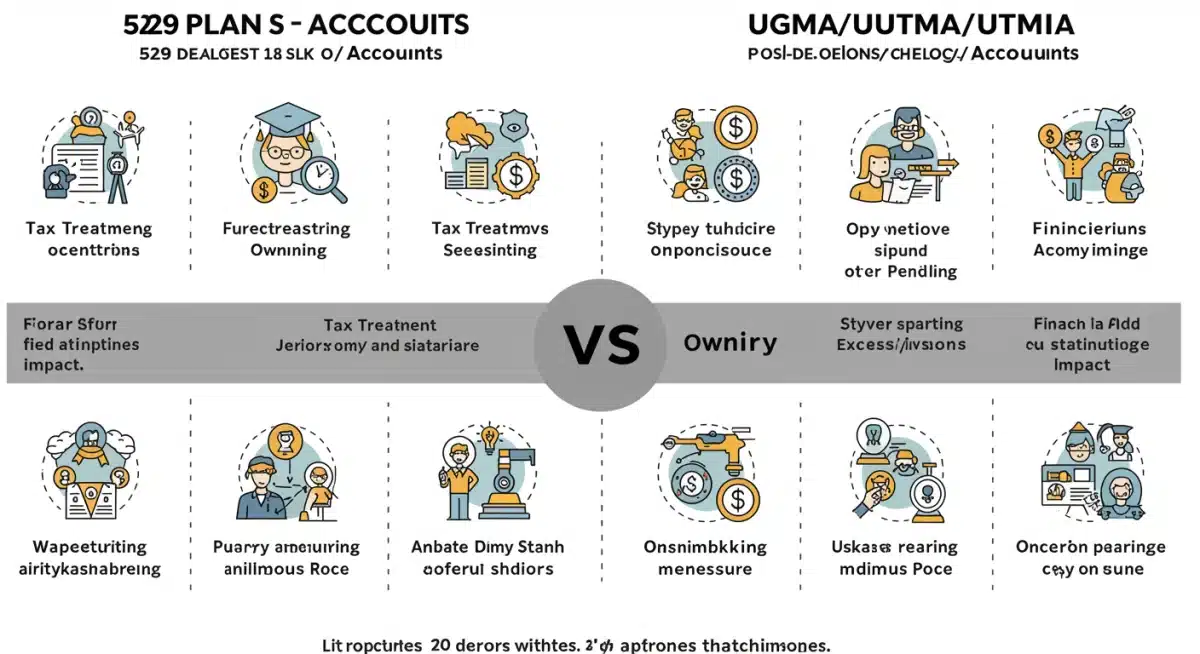
The core differences lie in tax treatment, ownership and control, and the impact on financial aid eligibility. Each of these aspects carries its own set of advantages and disadvantages, making a one-size-fits-all recommendation impossible. Instead, families must weigh these factors against their individual circumstances.
Tax Advantages and Disadvantages
As discussed, 529 plans offer tax-free growth and withdrawals for qualified education expenses, a substantial benefit that can significantly boost savings over time. UGMA/UTMA accounts, while offering some ‘kiddie tax’ benefits, generally have taxable earnings annually, which can erode returns compared to 529s.
For example, if you invest $10,000 in a 529 plan and it grows to $20,000 over 10 years, the $10,000 gain is tax-free if used for education. In an UGMA/UTMA, that $10,000 gain would be subject to annual taxes, reducing the overall accumulation. This difference often makes 529 plans more attractive purely from a tax perspective for education savings.
Ownership and Control Dynamics
This is perhaps the most significant divergence. With a 529 plan, the account owner (typically a parent) maintains control over the funds, even after the child reaches adulthood. They can change the beneficiary, withdraw funds (though non-qualified withdrawals are subject to taxes and a penalty), or simply let the money continue to grow for a future beneficiary. This control provides peace of mind that the funds will be used for their intended purpose.
Conversely, UGMA/UTMA accounts transfer full legal ownership to the child upon reaching the age of majority. At this point, the child has complete discretion over the funds – they can use it for college, a car, a trip, or anything else. While this fosters financial independence, it removes the parent’s ability to ensure the funds are used for education, a key consideration for many families.
Ultimately, the choice between these two vehicles depends on your priorities regarding tax efficiency, control over the assets, and the desired flexibility for the funds’ ultimate use. A careful evaluation of these aspects is crucial for effective college savings.
Impact on Financial Aid Eligibility
The way college savings accounts are treated in financial aid calculations is a critical factor for many US families. Both 529 plans and UGMA/UTMA accounts can affect a student’s eligibility for need-based financial aid, but they do so in different ways. Understanding these nuances is essential for maximizing potential aid packages.
Financial aid formulas, primarily the Free Application for Federal Student Aid (FAFSA), assess a family’s ability to pay for college based on their assets and income. The classification of an asset as belonging to the parent or the student significantly impacts the Expected Family Contribution (EFC), which in turn determines aid eligibility.
How 529 Plans Affect FAFSA
Generally, 529 plans owned by a parent are considered a parental asset on the FAFSA. Parental assets are assessed at a maximum rate of 5.64% of their value. This means that for every $10,000 in a parent-owned 529 plan, the EFC would increase by a maximum of $564. This is a relatively favorable treatment compared to student-owned assets.
Furthermore, distributions from a parent-owned 529 plan to pay for the beneficiary’s education are not counted as income for the student on the FAFSA. This is a significant advantage, as student income is assessed at a much higher rate (up to 50%) than parental assets. Grandparent-owned 529 plans, however, have historically presented a challenge, as distributions were counted as student income. Recent FAFSA simplification changes aim to mitigate this impact, making grandparent-owned 529 plans more appealing.
UGMA/UTMA and Financial Aid Assessment
UGMA/UTMA accounts, because they are legally owned by the student, are considered student assets on the FAFSA. Student assets are assessed at a much higher rate, typically 20% of their value. This means for every $10,000 in an UGMA/UTMA account, the EFC could increase by $2,000, significantly reducing eligibility for need-based aid.
Moreover, any distributions from an UGMA/UTMA account that are not spent on the student’s behalf during the year of the FAFSA application could be counted as student income in the following year, further impacting aid eligibility. This more aggressive assessment of student-owned assets often makes UGMA/UTMA accounts less desirable for families prioritizing need-based financial aid.
In conclusion, when financial aid is a significant concern, 529 plans typically offer a more advantageous position due to their classification as parental assets and the favorable treatment of distributions. UGMA/UTMA accounts, as student assets, can substantially reduce a student’s eligibility for need-based aid, making them a less strategic choice for many.
Choosing the Right Strategy for Your Family in 2025
Deciding between a 529 plan and an UGMA/UTMA account for your college savings strategies for 2025 requires careful consideration of your family’s unique financial situation, goals, and priorities. There isn’t a universally ‘best’ option; rather, the optimal choice depends on factors such as your income level, tax situation, desired control over funds, and expectations regarding financial aid.
For many families, especially those who anticipate needing financial aid or who want to ensure the funds are exclusively used for education, 529 plans often emerge as the more suitable choice. Their tax advantages and the ability for the account owner to retain control are compelling benefits.
Factors to Consider for 529 Plans
If you prioritize tax-free growth and withdrawals for education, and want to maintain control over how the funds are spent, a 529 plan is likely your best bet. Consider opening a plan in your home state to potentially benefit from state income tax deductions or credits. However, research plans from other states as well, as some offer more attractive investment options or lower fees, even if you don’t receive a state tax break.
- Tax Benefits: Maximize tax-free growth and withdrawals for qualified education expenses.
- Control: Account owner retains full control, preventing misuse by the beneficiary.
- Financial Aid Impact: Generally considered parental assets, impacting aid less severely than student assets.
When UGMA/UTMA Might Be a Fit
UGMA/UTMA accounts might be more appropriate in specific scenarios. For instance, if you want to gift assets to a minor for purposes beyond just education, or if you wish to instill financial responsibility early by giving the child full control upon reaching adulthood, these accounts offer that flexibility. They can also be useful if you’ve already maximized contributions to other college savings vehicles and are looking for another way to save, albeit with different tax and control implications.
It’s also worth noting that if your child is unlikely to qualify for need-based financial aid due to high family income, the higher assessment rate of student assets in UGMA/UTMA accounts might be less of a concern. In such cases, the flexibility they offer could become a more attractive feature.
Ultimately, a hybrid approach might also be viable, utilizing both a 529 plan for the bulk of education savings and an UGMA/UTMA for smaller gifts or for funds intended for broader purposes. Consulting with a financial advisor can provide personalized guidance based on your family’s unique circumstances.
Advanced Strategies and Considerations for 2025
As you refine your college savings strategies for 2025, it’s important to look beyond the basic comparisons and consider more advanced strategies and nuances. The financial landscape is constantly evolving, and staying informed can help optimize your savings and minimize potential pitfalls. This includes understanding potential rollovers, beneficiary changes, and the implications of using funds for non-qualified expenses.
For families with multiple children, or those whose education plans might shift, the flexibility of certain savings vehicles becomes even more critical. Proactive planning and periodic reviews of your chosen strategy are key to adapting to changing circumstances.
Rollovers and Beneficiary Changes
One of the significant advantages of 529 plans is the ability to change the beneficiary. If one child decides not to attend college, or if there are leftover funds, the account owner can often change the beneficiary to another eligible family member without tax consequences. This flexibility ensures that the funds can still be used for education within the family. Furthermore, recent legislation allows for limited rollovers from 529 plans to Roth IRAs, offering an exit strategy if education plans change.
UGMA/UTMA accounts, by contrast, offer no such flexibility. Once the assets are legally transferred to the minor, they cannot be transferred to another beneficiary or rolled over to a different type of account without being distributed to the now-adult child, who then has full control and can do as they please with the funds.
Non-Qualified Withdrawals and Penalties
While 529 plans are designed for education, life happens, and sometimes funds may need to be withdrawn for non-qualified expenses. In such cases, the earnings portion of the withdrawal will be subject to federal income tax and typically a 10% federal penalty tax. Some states may also recapture previously claimed tax deductions or credits. It’s crucial to understand these potential consequences before making a non-qualified withdrawal.
With UGMA/UTMA accounts, there are no specific penalties for using the funds for non-education purposes once the child reaches the age of majority. However, the gains within the account have been subject to annual taxation, and any spending decisions are solely at the discretion of the now-adult child, which may or may not align with the original gifting intent.
Considering these advanced aspects helps paint a more complete picture of each savings vehicle. The long-term implications of flexibility, control, and potential penalties should be thoroughly evaluated as part of your overall college savings strategy.
The Role of Professional Guidance in College Savings
Navigating the intricacies of college savings strategies for 2025 can be complex, and making the right choices often benefits from professional guidance. A qualified financial advisor can provide personalized insights, help you understand the nuances of 529 plans and UGMA/UTMA accounts, and integrate these decisions into your broader financial plan. Their expertise can be invaluable in optimizing your savings and achieving your educational goals.
The landscape of college funding, tax laws, and financial aid regulations is constantly changing. What was true last year might not be true this year, and what applies to one family might not apply to another. This is where professional advice becomes particularly critical.
Benefits of Consulting a Financial Advisor
A financial advisor can help you assess your current financial situation, determine your risk tolerance, and project future college costs. They can then recommend the most suitable savings vehicles, whether it’s a 529 plan, an UGMA/UTMA, or a combination of different strategies. They can also assist with the practical aspects of setting up accounts and managing investments.
- Personalized Strategy: Tailored advice based on your family’s unique financial situation and goals.
- Tax Optimization: Guidance on maximizing tax benefits and minimizing tax liabilities.
- Financial Aid Planning: Understanding how different savings vehicles impact aid eligibility.
- Investment Management: Help with selecting appropriate investment options within your chosen accounts.
Integrated Financial Planning
College savings should not be viewed in isolation. A good financial advisor will help you integrate your college savings plan with other financial goals, such as retirement planning, homeownership, and estate planning. They can help you prioritize these goals and ensure that your strategies are aligned across all areas of your financial life.
Moreover, a financial advisor can provide ongoing support, helping you review and adjust your college savings plan as your circumstances change or as new regulations come into effect. This iterative process ensures that your strategy remains effective and aligned with your evolving needs, offering peace of mind and greater confidence in your financial future.
Engaging with a financial professional is an investment that can yield significant returns in the form of optimized savings, reduced stress, and a clearer path to funding your child’s education. Don’t hesitate to seek expert advice to make the most informed decisions for your family.
| Key Feature | Description |
|---|---|
| Tax Benefits | 529 plans offer tax-free growth and withdrawals for qualified education expenses; UGMA/UTMA has ‘kiddie tax’ rules and taxable gains. |
| Asset Ownership | 529 plans are parent-owned, while UGMA/UTMA accounts are legally owned by the minor. |
| Financial Aid Impact | 529 plans are assessed as parental assets (lower impact); UGMA/UTMA as student assets (higher impact). |
| Control Over Funds | 529 plan owner retains control; UGMA/UTMA funds transfer to child at age of majority. |
Frequently Asked Questions About College Savings
529 plans offer federal tax-free growth on investments and federal tax-free withdrawals when funds are used for qualified education expenses. Many states also provide tax deductions or credits for contributions, further enhancing their tax efficiency for families saving for college.
In an UGMA/UTMA account, the minor is the legal owner of the assets, managed by a custodian until they reach the age of majority. Conversely, a 529 plan’s assets are owned by the account holder (typically a parent), who retains control even after the beneficiary becomes an adult.
Generally, 529 plans have a more favorable impact on financial aid eligibility. They are assessed as parental assets at a lower rate (up to 5.64%). UGMA/UTMA accounts are student assets, assessed at a higher rate (20%), potentially reducing need-based aid significantly.
Yes, 529 plan funds can be used for a wide range of qualified education expenses, including room and board, books, supplies, and equipment. They can also cover K-12 tuition up to $10,000 annually and certain apprenticeship program costs, offering considerable flexibility.
Upon reaching the age of majority (typically 18 or 21, depending on the state), the child gains full and unrestricted control over all assets in the UGMA/UTMA account. They can then use the funds for any purpose they choose, without parental oversight or limitations.
Conclusion
Choosing the optimal college savings strategy for 2025 is a pivotal decision for US families. Both 529 plans and UGMA/UTMA accounts offer distinct advantages and disadvantages that must be carefully weighed against your family’s financial goals, tax situation, and desired level of control. While 529 plans often provide superior tax benefits and greater control for education-specific savings, UGMA/UTMA accounts offer broader flexibility for gifting assets and fostering financial independence in minors. Regardless of the path chosen, early and consistent saving, coupled with informed decision-making, remains the cornerstone of securing a strong educational future for your children. Consulting with a financial advisor can provide invaluable personalized guidance to navigate these complex choices effectively.