Build a Diversified Portfolio 2026: Long-Term Growth Guide

Building a Diversified Portfolio in 2026: A Step-by-Step Guide for Long-Term Growth and Stability
The financial landscape is ever-evolving, and 2026 presents both new challenges and exciting opportunities for investors. As we navigate a world shaped by technological advancements, shifting geopolitical dynamics, and evolving economic policies, the importance of a well-structured and diversified portfolio 2026 cannot be overstated. This comprehensive guide will walk you through the essential steps to build a robust investment portfolio designed for sustained long-term growth and stability, helping you achieve your financial aspirations.
Investing isn’t merely about picking winning stocks; it’s about strategically allocating your capital across various asset classes to mitigate risk and maximize returns over time. A truly effective diversified portfolio 2026 considers your individual financial goals, risk tolerance, and the prevailing market conditions. By the end of this article, you’ll have a clear roadmap to construct a portfolio that stands resilient against market volatility and capitalizes on future opportunities.
Understanding the Core Principles of Diversification
Before diving into specific asset classes and strategies, it’s crucial to grasp the fundamental concept of diversification. At its heart, diversification is about not putting all your eggs in one basket. It’s a risk management strategy that mixes a wide variety of investments within a portfolio. The rationale behind this technique is that a portfolio constructed of different kinds of assets will, on average, yield higher returns and pose a lower risk than any individual investment found within the portfolio.
Why is Diversification Crucial for Your 2026 Portfolio?
- Risk Mitigation: Different asset classes react differently to market events. When one asset performs poorly, another might be performing well, thus offsetting potential losses. This smoothing effect is vital for long-term stability.
- Enhanced Returns: While often associated with risk reduction, diversification can also lead to better risk-adjusted returns. By combining assets that are not perfectly correlated, you can potentially achieve higher returns for a given level of risk.
- Adaptability: A diversified portfolio is more adaptable to changing economic conditions. If a particular sector or region faces headwinds, your exposure to other areas can help cushion the impact.
- Long-Term Resilience: Market cycles are inevitable. A diversified approach helps your portfolio weather downturns and participate in upturns, contributing to consistent growth over many years.
For your diversified portfolio 2026, understanding these principles is the bedrock upon which you’ll build your investment strategy. It’s not just about having many different investments, but about having investments that behave differently under various market conditions.
Step 1: Define Your Financial Goals and Risk Tolerance
Every successful investment journey begins with a clear understanding of where you want to go and how much risk you’re willing to take to get there. This initial step is paramount for shaping your diversified portfolio 2026.
Setting Clear Financial Goals
What are you investing for? Retirement, a down payment on a house, your child’s education, or simply wealth accumulation? Your goals will dictate your investment horizon and the urgency of your returns. Clearly defined goals help you stay focused and avoid impulsive decisions during market fluctuations.
- Short-Term Goals (1-3 years): These might include saving for a vacation or a new car. Such goals typically require more conservative investments with lower risk and higher liquidity.
- Medium-Term Goals (3-10 years): Examples include a house down payment or starting a business. A balanced approach with a mix of growth and stability is often suitable here.
- Long-Term Goals (10+ years): Retirement planning and generational wealth building fall into this category. These goals allow for a more aggressive allocation towards growth-oriented assets, as there’s ample time to recover from market downturns.
Assessing Your Risk Tolerance
Your risk tolerance is your psychological willingness and financial ability to take on risk. It’s a crucial factor in determining the asset allocation of your diversified portfolio 2026.
- Conservative Investor: Prioritizes capital preservation, willing to accept lower returns for greater stability.
- Moderate Investor: Seeks a balance between growth and safety, comfortable with some market fluctuations.
- Aggressive Investor: Aims for high returns, willing to take on significant risk and endure substantial market volatility.
Be honest with yourself about your risk tolerance. An overly aggressive portfolio can lead to panic selling during downturns, undermining your long-term goals. Conversely, an overly conservative portfolio might not generate the returns needed to reach your objectives. Many financial advisors use questionnaires to help gauge risk tolerance accurately.
Step 2: Strategic Asset Allocation for Your Diversified Portfolio 2026
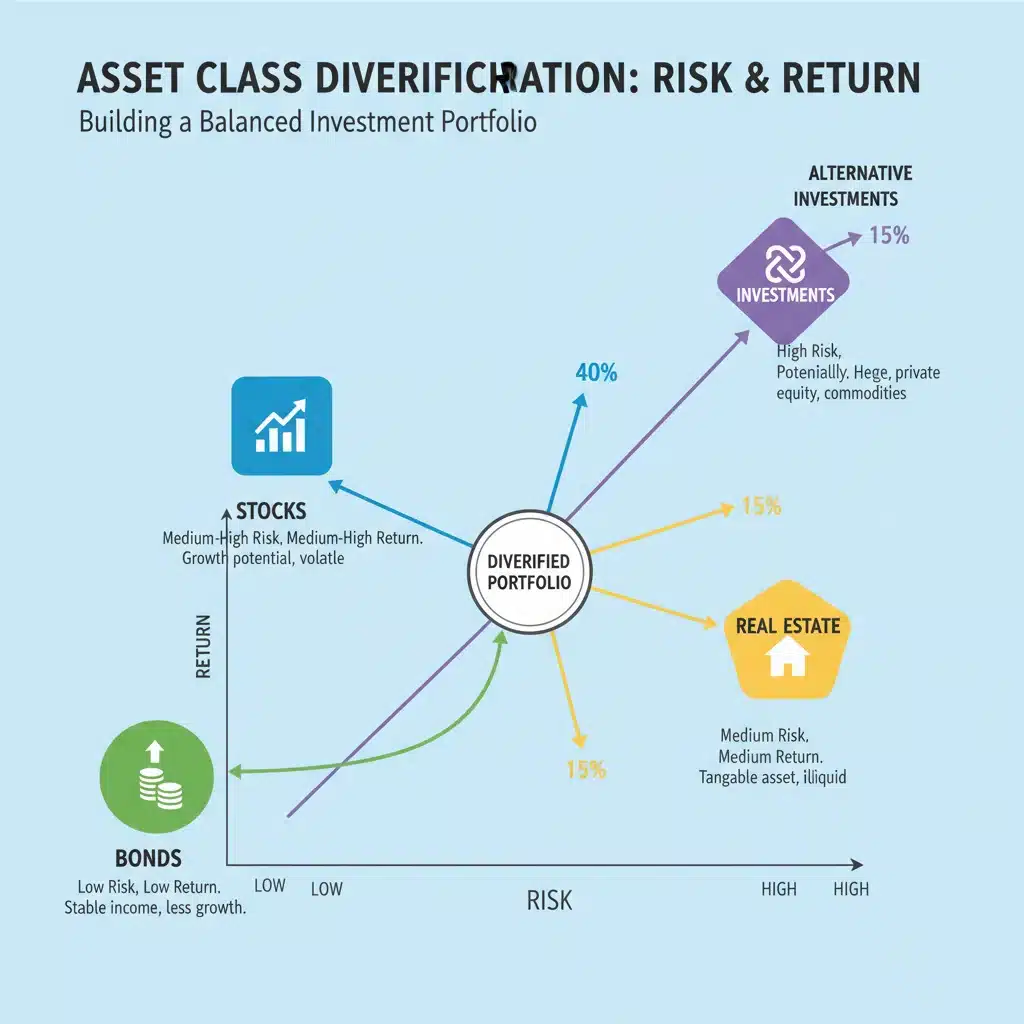
Once your goals and risk tolerance are established, the next critical step is asset allocation. This involves dividing your investment capital among different asset classes, such as stocks, bonds, real estate, and alternative investments. The right asset allocation is the cornerstone of a truly diversified portfolio 2026.
Key Asset Classes to Consider
Let’s explore the primary asset classes and their roles in a diversified portfolio:
1. Equities (Stocks)
Stocks represent ownership in a company and offer the potential for significant capital appreciation and dividends. They are generally considered higher-risk, higher-reward investments.
- Large-Cap Stocks: Companies with large market capitalizations (e.g., Apple, Microsoft). Often more stable, but with potentially slower growth.
- Mid-Cap Stocks: Companies with medium market capitalizations. Offer a balance of growth potential and stability.
- Small-Cap Stocks: Smaller companies with high growth potential, but also higher volatility.
- International Stocks: Investing in companies outside your home country provides geographical diversification, reducing reliance on a single economy. Emerging markets can offer high growth but also higher risk.
- Growth Stocks: Companies expected to grow earnings at an above-average rate.
- Value Stocks: Companies that appear to be undervalued by the market, often with stable earnings and dividends.
2. Fixed Income (Bonds)
Bonds are debt instruments issued by governments or corporations. They are generally considered lower-risk than stocks, providing regular income payments and capital preservation. Bonds play a crucial role in stabilizing a diversified portfolio 2026.
- Government Bonds: Issued by national governments (e.g., U.S. Treasuries). Generally considered very low risk.
- Corporate Bonds: Issued by companies. Offer higher yields than government bonds but come with greater credit risk.
- Municipal Bonds: Issued by state and local governments, often offering tax advantages.
- Inflation-Protected Securities (TIPS): Bonds whose principal value adjusts with inflation, protecting against purchasing power erosion.
3. Real Estate
Real estate can offer income through rent and appreciation in property value. It often has a low correlation with stocks and bonds, making it an excellent diversifier.
- Direct Ownership: Owning physical properties (residential, commercial). Requires significant capital and management.
- Real Estate Investment Trusts (REITs): Companies that own, operate, or finance income-producing real estate. They trade like stocks and offer liquidity.
- Real Estate Crowdfunding: Investing in real estate projects with other investors, requiring less capital than direct ownership.
4. Alternative Investments
This broad category includes assets like commodities, private equity, hedge funds, and cryptocurrencies. They can offer unique return streams and further enhance portfolio diversification.
- Commodities: Raw materials like gold, oil, and agricultural products. Can act as an inflation hedge.
- Cryptocurrencies: Digital assets like Bitcoin and Ethereum. High risk, high reward, and highly volatile. Should be a small portion of a diversified portfolio 2026, if included at all.
- Private Equity: Investments in companies not publicly traded. High potential returns but illiquid.
Crafting Your Allocation Strategy for 2026
The ideal asset allocation depends on your risk tolerance and time horizon. Here are some general guidelines:
- Younger Investors (Long Time Horizon, Higher Risk Tolerance): May allocate a larger percentage to growth-oriented assets like stocks (e.g., 70-80% stocks, 20-30% bonds/alternatives).
- Middle-Aged Investors (Medium Time Horizon, Moderate Risk Tolerance): A more balanced approach (e.g., 50-60% stocks, 30-40% bonds, 5-10% alternatives/real estate).
- Older Investors (Short Time Horizon, Lower Risk Tolerance): Focus on capital preservation and income (e.g., 30-40% stocks, 50-60% bonds, 5-10% other).
Remember, these are just guidelines. Your personal circumstances should always dictate your specific allocation for your diversified portfolio 2026.
Step 3: Implementing Your Portfolio with Investment Vehicles
Once you’ve decided on your asset allocation, the next step is to choose the actual investment vehicles to implement your strategy. For your diversified portfolio 2026, common choices include mutual funds, Exchange Traded Funds (ETFs), and individual securities.
Mutual Funds and ETFs
These are popular choices for diversification as they allow you to invest in a basket of securities with a single purchase.
- Mutual Funds: Professionally managed funds that pool money from many investors to purchase securities. They offer diversification and professional management but can have higher fees and are traded only once a day after market close.
- ETFs (Exchange Traded Funds): Similar to mutual funds, but they trade like stocks on an exchange throughout the day. ETFs generally have lower expense ratios than mutual funds and offer excellent diversification across various sectors, geographies, and asset classes. They are an excellent tool for building a diversified portfolio 2026.
Individual Stocks and Bonds
For experienced investors, selecting individual stocks and bonds can offer greater control and potentially higher returns, but it also carries higher risk and requires more research.
- Stocks: If you choose individual stocks, ensure you diversify across different industries and company sizes.
- Bonds: Individual bonds can be suitable for specific income needs, but bond funds/ETFs often provide better diversification.
Robo-Advisors
For those new to investing or who prefer a hands-off approach, robo-advisors can be a great option. These automated platforms build and manage diversified portfolios based on your risk tolerance and goals, often with lower fees than traditional financial advisors.
Step 4: Regular Monitoring and Rebalancing Your Diversified Portfolio 2026
Building a diversified portfolio 2026 is not a one-time event; it’s an ongoing process. Regular monitoring and periodic rebalancing are essential to ensure your portfolio remains aligned with your financial goals and risk tolerance.
Why Rebalance?
Over time, the performance of different asset classes will cause your portfolio’s original allocation to drift. For example, if stocks perform exceptionally well, they might grow to represent a larger percentage of your portfolio than initially intended, increasing your overall risk exposure. Rebalancing involves selling some of the overperforming assets and buying more of the underperforming ones to restore your target asset allocation.
When to Rebalance?
- Time-Based Rebalancing: Many investors choose to rebalance annually or semi-annually. This provides a structured approach and prevents emotional decision-making.
- Threshold-Based Rebalancing: You can rebalance when an asset class deviates by a certain percentage (e.g., 5% or 10%) from its target allocation. This allows for more dynamic adjustments.
- Life Events: Major life changes, such as getting married, having children, or nearing retirement, should prompt a review and potential rebalancing of your portfolio.
Consistent rebalancing helps maintain your desired risk level and ensures you’re buying low and selling high, a cornerstone of successful long-term investing for your diversified portfolio 2026.
Step 5: Considering 2026 Market Trends and Future-Proofing Your Portfolio
While the core principles of diversification remain timeless, a truly effective diversified portfolio 2026 must also account for current and anticipated market trends. Staying informed and making strategic adjustments can position your portfolio for optimal performance.
Key Trends to Watch in 2026
- Technological Innovation: Areas like Artificial Intelligence (AI), quantum computing, biotechnology, and renewable energy are likely to continue their rapid growth. Consider growth-oriented ETFs or specific companies in these sectors.
- Inflationary Pressures: Depending on economic policies and global supply chains, inflation could remain a concern. Assets like real estate, commodities, and inflation-protected bonds can act as hedges.
- Interest Rate Environment: Central bank policies on interest rates will impact bond yields and borrowing costs. A rising rate environment generally favors shorter-duration bonds.
- Geopolitical Landscape: Global events can significantly impact markets. Geographical diversification becomes even more critical in an uncertain world.
- ESG Investing: Environmental, Social, and Governance (ESG) factors are increasingly influencing investment decisions. Companies with strong ESG practices may see greater investor interest and long-term resilience.

Future-Proofing Strategies
- Dynamic Asset Allocation: While your core allocation should be stable, consider making small tactical adjustments to capitalize on short-to-medium term trends without abandoning your long-term strategy.
- Embrace Global Markets: Don’t limit your diversified portfolio 2026 to domestic investments. Global diversification reduces country-specific risk and opens up opportunities in fast-growing economies.
- Stay Liquid: Maintain an emergency fund outside your investment portfolio to avoid being forced to sell investments during market downturns.
- Continuous Learning: The investment world is constantly changing. Stay educated about new investment vehicles, economic theories, and market dynamics.
Advanced Diversification Techniques for Your 2026 Portfolio
Beyond the basic asset classes, more sophisticated investors might consider additional layers of diversification to further optimize their diversified portfolio 2026.
Diversification by Industry/Sector
Within equities, ensure you’re not overly concentrated in a single industry. For example, relying solely on tech stocks, even if they’re performing well, can expose you to significant risk if that sector faces a downturn. Spread your equity investments across various sectors like healthcare, consumer staples, industrials, financials, and utilities.
Diversification by Geography
Investing in international markets helps reduce country-specific risk. Economic conditions, political stability, and market regulations vary significantly across regions. A global exposure ensures your portfolio isn’t solely dependent on the performance of a single national economy.
Diversification by Investment Style
Consider a mix of growth and value stocks, as well as different market capitalizations (small, mid, and large-cap). These different styles tend to perform well at different points in the economic cycle, providing a smoother return profile for your diversified portfolio 2026.
Diversification by Investment Manager/Strategy
If you’re using actively managed funds, consider using funds from different managers who employ varied investment philosophies. This adds another layer of diversification against manager-specific risk.
Common Pitfalls to Avoid When Building Your Diversified Portfolio 2026
Even with the best intentions, investors can fall prey to common mistakes that undermine their diversification efforts.
- Over-Diversification (Diworsification): While diversification is good, too much of it can dilute returns and make the portfolio unwieldy to manage. It’s about strategic diversification, not just owning hundreds of different things.
- Chasing Returns: Investing in assets purely because they performed well in the recent past is a common mistake. Past performance is not indicative of future results. Stick to your long-term strategy.
- Emotional Investing: Panic selling during downturns or buying into speculative bubbles driven by fear or greed can severely damage your portfolio. Adhere to your pre-defined plan and rebalancing strategy.
- Ignoring Fees: High expense ratios on mutual funds or excessive trading fees can significantly erode your returns over time. Be mindful of costs.
- Lack of Rebalancing: As discussed, failing to rebalance means your portfolio will drift from your target allocation, potentially exposing you to more risk than intended.
- Home Country Bias: Over-investing in your domestic market and neglecting international opportunities. This limits diversification and potential returns.
Tax Efficiency in Your Diversified Portfolio 2026
Beyond asset allocation and risk management, considering tax efficiency is crucial for maximizing your net returns. The strategies you employ for your diversified portfolio 2026 can significantly impact how much of your investment gains you actually keep.
Utilizing Tax-Advantaged Accounts
One of the most effective ways to boost tax efficiency is to make full use of tax-advantaged retirement accounts, such as:
- 401(k)s and 403(b)s: Employer-sponsored plans offering tax-deferred growth (traditional) or tax-free withdrawals in retirement (Roth).
- Individual Retirement Accounts (IRAs): Traditional IRAs offer tax-deductible contributions and tax-deferred growth, while Roth IRAs offer tax-free growth and withdrawals in retirement.
- Health Savings Accounts (HSAs): A triple-tax-advantaged account (tax-deductible contributions, tax-free growth, tax-free withdrawals for qualified medical expenses) that can also function as an investment vehicle.
By placing your most tax-inefficient assets (e.g., high-turnover funds, bonds that generate taxable interest) in these accounts, you can shield a significant portion of your gains from annual taxation.
Tax-Loss Harvesting
This strategy involves selling investments at a loss to offset capital gains and, potentially, a limited amount of ordinary income. While it shouldn’t dictate your investment decisions, judicious tax-loss harvesting can improve the after-tax returns of your diversified portfolio 2026, especially in taxable brokerage accounts.
Location of Assets (Asset Location)
Consider where you hold different types of assets. For instance, growth stocks or highly appreciating assets might be better suited for Roth accounts where future withdrawals are tax-free. Bonds, which generate taxable interest income, could be placed in tax-deferred accounts like a traditional 401(k) or IRA.
Minimizing Turnover
Frequent buying and selling, especially in taxable accounts, can generate short-term capital gains, which are taxed at higher ordinary income rates. Opting for low-turnover index funds or ETFs can help minimize these taxable events and allow your investments to grow more efficiently.
The Role of Professional Advice in Building Your Diversified Portfolio 2026
While this guide provides a comprehensive framework, navigating the complexities of investment and personal finance can be daunting. For many, seeking professional advice is a wise decision to ensure their diversified portfolio 2026 is optimally structured and managed.
When to Consider a Financial Advisor
- Complex Financial Situation: If you have significant assets, multiple income streams, or specific estate planning needs.
- Lack of Time or Expertise: If you don’t have the time, interest, or knowledge to actively manage your investments.
- Emotional Control: An advisor can act as a rational sounding board, helping you avoid emotional decisions during market volatility.
- Goal Setting and Planning: Advisors can help clarify your financial goals, assess your risk tolerance, and create a personalized financial plan.
- Tax Optimization: They can provide expert advice on tax-efficient investing and estate planning strategies.
Choosing the Right Advisor
If you decide to engage a financial advisor for your diversified portfolio 2026, look for:
- Fiduciary Duty: Ensure they are a fiduciary, meaning they are legally obligated to act in your best interest.
- Certifications: Look for Certified Financial Planners (CFPs) or other recognized professional designations.
- Fee Structure: Understand how they are compensated (e.g., fee-only, commission-based). Fee-only advisors generally have fewer conflicts of interest.
- Experience and Specialization: Choose an advisor with experience relevant to your specific needs and goals.
A good financial advisor won’t just pick investments; they’ll help you develop a holistic financial plan that integrates your investments with your overall life goals, providing invaluable support for your diversified portfolio 2026.
Conclusion: Your Path to a Resilient Diversified Portfolio 2026
Building a diversified portfolio 2026 is a journey that requires careful planning, consistent execution, and periodic adjustments. By defining your financial goals, understanding your risk tolerance, strategically allocating your assets across various classes, and regularly monitoring and rebalancing your investments, you lay the groundwork for long-term financial success.
The year 2026, like any other, will present its unique set of market dynamics. However, the core principles of diversification remain your most powerful tool against uncertainty. Embrace the opportunities presented by technological advancements, global markets, and evolving investment vehicles, but always anchor your decisions in a well-thought-out, diversified strategy.
Remember that patience and discipline are key. Market fluctuations are normal, and a diversified portfolio is designed to weather these storms, allowing you to stay focused on your long-term objectives. Whether you manage your investments yourself or seek professional guidance, commit to the process, stay informed, and empower your diversified portfolio 2026 to grow resiliently for years to come.