AI Reshaping 2026 U.S. Job Market: Education & Training
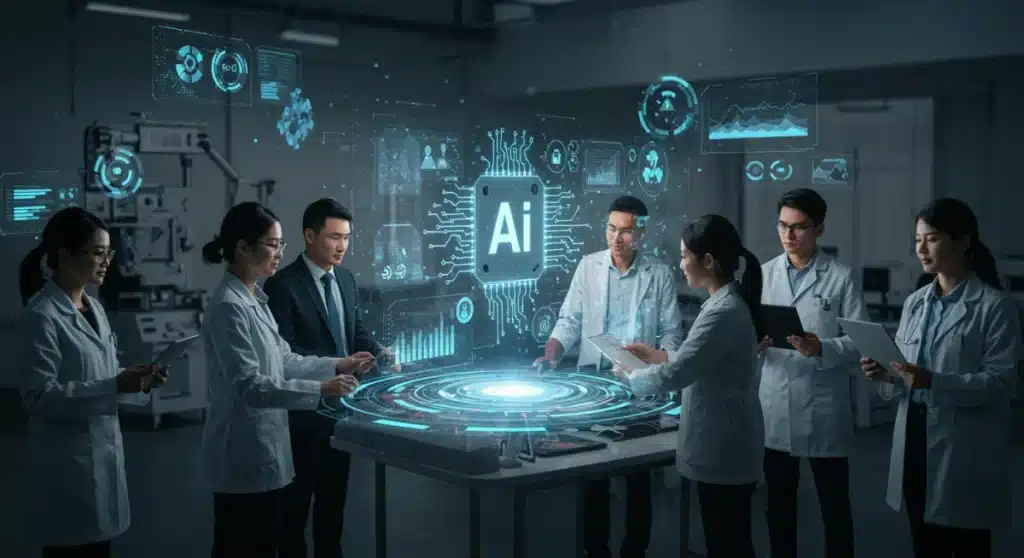
The U.S. job market by 2026 is undergoing a profound transformation driven by artificial intelligence, necessitating a critical re-evaluation and adaptation of education and training programs to prepare the workforce for new demands.
The landscape of work is perpetually evolving, but the acceleration brought about by artificial intelligence (AI) is unprecedented. By 2026, AI Job Market 2026 trends indicate a significant shift in demanded skills and available roles, requiring proactive adaptation from both individuals and educational institutions across the United States.
Understanding the AI Impact on U.S. Employment by 2026
The integration of artificial intelligence into various industries is not a distant future concept; it is happening now and will be profoundly evident in the U.S. job market by 2026. This technological revolution is automating routine tasks, augmenting human capabilities, and creating entirely new job categories that demand a novel skill set.
Many traditional roles are being redefined, while others may diminish. However, this transformation also sparks immense opportunities for innovation and growth. Understanding these shifts is the first step towards effective preparation and strategic career planning for the coming years.
Automation and Job Displacement
While often feared, automation by AI does not always equate to job loss. Instead, it often reallocates human effort to more complex, creative, and strategic tasks. Industries like manufacturing, logistics, and customer service are experiencing significant automation.
- Repetitive tasks are increasingly handled by AI.
- Data entry and routine analysis are prime candidates for automation.
- Certain customer support interactions are now AI-driven.
Emergence of New Roles
The rise of AI also creates a demand for new specialized roles. These include positions in AI development, ethical AI oversight, data science, and human-AI collaboration management. These jobs require a blend of technical prowess and soft skills.
- AI ethics officers ensure responsible AI deployment.
- Prompt engineers optimize AI interactions.
- AI system trainers refine machine learning models.
The net effect is a dynamic equilibrium where some jobs are automated, others are augmented, and entirely new ones are created. The crucial aspect is the need for continuous learning and adaptability to navigate this evolving professional landscape successfully.
Reshaping Education: Curricula for the AI Era
As the U.S. job market shifts, so too must the educational frameworks that prepare its workforce. Traditional curricula, while foundational, often lack the agility to keep pace with rapid technological advancements. By 2026, educational institutions are expected to integrate AI-centric learning more deeply, from K-12 to higher education.
This integration goes beyond simply teaching coding; it encompasses critical thinking about AI’s implications, understanding data literacy, and fostering creativity alongside technical skills. The goal is to produce graduates who are not just users of technology, but informed participants in an AI-driven world.
Integrating AI Literacy from K-12
Early exposure to AI concepts is becoming crucial. Introducing computational thinking, basic programming logic, and the ethical considerations of AI at younger ages can build a strong foundation. This prepares students for more advanced studies and future careers.
- Computational thinking skills are being emphasized.
- Basic coding and algorithmic principles are introduced.
- Discussions on AI ethics and societal impact begin early.
Higher Education’s Pivotal Role
Universities and colleges are at the forefront of developing specialized AI programs. This includes degrees in AI engineering, machine learning, data science, and AI-focused interdisciplinary studies. Furthermore, existing programs are being updated to include AI modules relevant to their fields.
- New AI-specific degrees and specializations are emerging.
- Traditional disciplines like law and medicine are incorporating AI applications.
- Research into advanced AI topics is expanding rapidly.
The reshaping of education is not merely an upgrade; it’s a fundamental reimagining of what it means to be educated in an era where intelligence, both human and artificial, defines progress. This ensures students are equipped with both current and future-proof skills.
Upskilling and Reskilling the Existing Workforce
For those already in the workforce, the changes brought by AI present both challenges and opportunities. The need for continuous learning, or lifelong learning, has never been more critical. Upskilling involves enhancing existing skills with AI competencies, while reskilling means acquiring entirely new skills for different roles. Both are vital strategies for career resilience in the AI Job Market 2026.
Companies, government agencies, and individuals are recognizing the imperative to invest in these programs. This proactive approach helps prevent skill gaps, maintains competitiveness, and ensures a smooth transition for workers affected by automation. The focus is on practical, applicable skills that can be immediately leveraged.
Corporate Training Initiatives
Many forward-thinking companies are launching internal training programs to upskill their employees. These initiatives often focus on AI tools relevant to their specific industry, data analysis, and advanced problem-solving techniques. Investing in employees’ skills can lead to increased productivity and innovation.
- Customized AI training for specific business functions.
- Workshops on data interpretation and machine learning tools.
- Programs to develop soft skills like adaptability and critical thinking.
Government-Backed Programs and Community Colleges
Government funding and partnerships with community colleges are creating accessible reskilling opportunities. These programs often target workers in sectors most affected by automation, providing pathways to high-demand AI-related jobs. They are crucial for ensuring equitable access to new career paths.
- Subsidized courses in AI and data science.
- Certifications for emerging tech roles.
- Career counseling and job placement assistance.
The commitment to upskilling and reskilling reflects an understanding that a robust economy relies on an adaptable and well-trained workforce. These efforts ensure that the benefits of AI are shared broadly, fostering economic stability and growth for all.
The Role of Online Learning and Micro-credentials
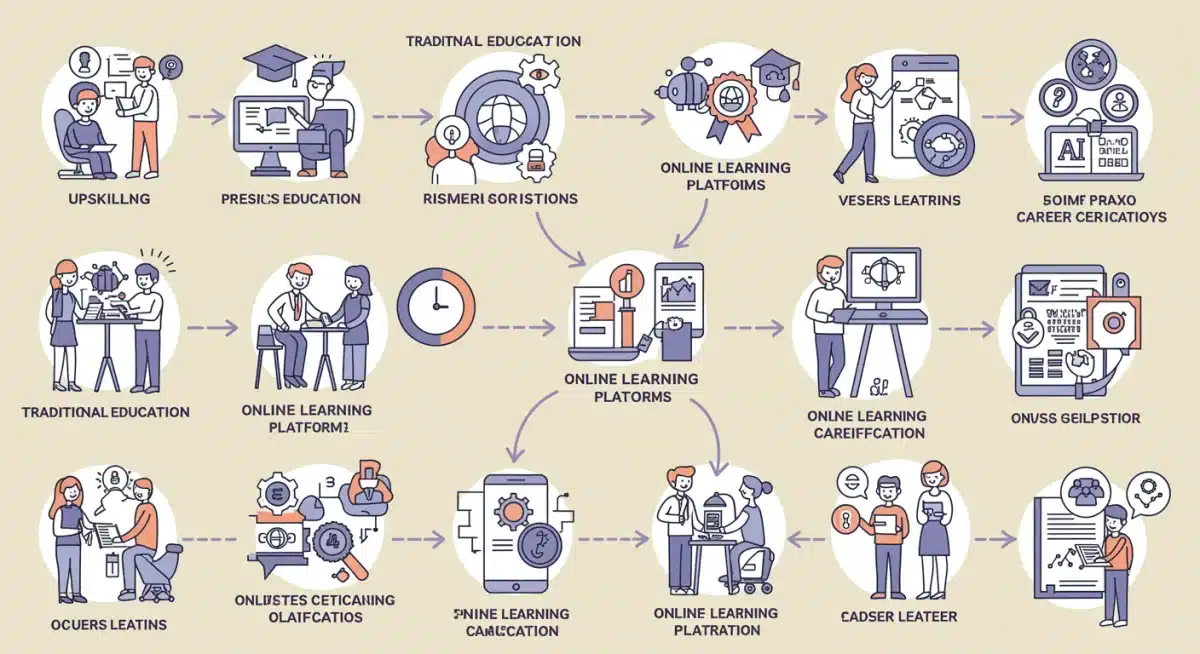
The rapid pace of technological change necessitates flexible and accessible learning options. Online learning platforms and micro-credential programs are emerging as powerful tools to meet this demand, particularly in the context of the AI Job Market 2026. These platforms offer individuals the ability to acquire specific skills quickly and efficiently, often without the time or financial commitment of a traditional degree.
From specialized AI courses to certifications in data analytics or cloud computing, these resources are democratizing access to essential skills. They enable continuous learning, allowing professionals to stay current with industry trends and pivot their careers as needed. This flexibility is key to navigating an unpredictable future.
Accessibility and Flexibility
Online learning breaks down geographical barriers and offers unparalleled flexibility. Individuals can learn at their own pace, balancing their studies with work and personal commitments. This accessibility is vital for adult learners who need to adapt their skills without interrupting their careers.
- Self-paced courses cater to diverse schedules.
- Content can be accessed from anywhere with an internet connection.
- Affordable options make continuous learning more attainable.
The Value of Micro-credentials
Micro-credentials, such as badges, certificates, and nanodegrees, validate specific skill sets. They are highly valued by employers looking for targeted expertise, offering a faster route to demonstrating proficiency than a full degree. These credentials are particularly effective for rapidly evolving fields like AI.
- Certifications in machine learning, data engineering, and AI ethics.
- Badges for proficiency in specific AI tools or programming languages.
- Short courses focused on practical, job-relevant skills.
The proliferation of online learning and micro-credentials signifies a paradigm shift in how skills are acquired and recognized. They empower individuals to take ownership of their professional development, ensuring they remain relevant and competitive in the evolving job market.
Ethical Considerations and Human-Centric AI Skills
Beyond technical proficiency, the AI Job Market 2026 will place significant emphasis on ethical considerations and human-centric skills. As AI systems become more prevalent and powerful, understanding their societal impact, ensuring fairness, and addressing bias are paramount. Education and training programs must therefore integrate these critical non-technical aspects.
Developing skills like critical thinking, creativity, emotional intelligence, and complex problem-solving will distinguish human workers in an AI-augmented world. These are the abilities that AI currently struggles to replicate, making them increasingly valuable and essential for future roles.
AI Ethics and Responsible Development
Educating professionals on the ethical implications of AI is no longer optional. Courses on AI ethics, bias detection, privacy concerns, and responsible deployment are becoming integral. This ensures that AI technologies are developed and used in ways that benefit society and uphold human values.
- Understanding algorithmic bias and its mitigation.
- Designing AI systems with privacy by design principles.
- Developing frameworks for ethical AI governance.
Cultivating Uniquely Human Skills
While AI excels at data processing, human attributes like creativity, empathy, and strategic thinking remain irreplaceable. Educational programs are increasingly focusing on fostering these skills, recognizing their importance in roles that involve complex decision-making, innovation, and interpersonal interaction.
- Enhancing critical thinking and adaptive problem-solving.
- Developing emotional intelligence for effective team collaboration.
- Fostering creativity and innovative approaches to challenges.
By balancing technical expertise with a strong foundation in ethics and human-centric skills, the workforce of 2026 will be better equipped to harness AI’s potential responsibly and effectively, creating a more just and productive future.
Preparing for the Future: Strategic Career Planning
Navigating the evolving AI Job Market 2026 demands a strategic approach to career planning. It’s no longer enough to simply acquire a degree and expect it to last a lifetime. Individuals must become proactive architects of their professional journeys, continuously assessing market trends, identifying skill gaps, and pursuing targeted learning opportunities. This involves foresight, adaptability, and a commitment to lifelong learning.
Strategic career planning in the AI era means understanding that career paths may not be linear. It encourages exploring interdisciplinary roles, embracing new technologies, and leveraging human strengths that complement AI capabilities. This forward-looking mindset is essential for sustained success.
Continuous Learning and Adaptability
The most successful professionals in 2026 will be those who embrace continuous learning. This means regularly updating skills, staying informed about technological advancements, and being willing to adapt to new roles or industries. Adaptability is a key trait that allows individuals to pivot effectively.
- Regularly evaluating industry reports and future trends.
- Seeking out new learning opportunities and certifications.
- Being open to career transitions and skill re-evaluation.
Leveraging Hybrid Skills and Interdisciplinary Approaches
The future workforce will increasingly value individuals with hybrid skill sets – a combination of technical AI knowledge and soft skills like communication, collaboration, and creativity. Interdisciplinary approaches, combining AI with fields like psychology, design, or business, will unlock new opportunities and innovative solutions.
- Combining technical AI skills with strong communication abilities.
- Exploring roles at the intersection of AI and humanities.
- Developing project management skills for AI-driven initiatives.
Ultimately, strategic career planning in the age of AI is about empowerment. It’s about taking control of one’s professional destiny by proactively preparing for change, embracing new knowledge, and cultivating a resilient and adaptable mindset for the opportunities ahead.
| Key Aspect | Brief Description |
|---|---|
| AI Job Market Shift | Automation redefines roles, creates new AI-centric positions, and demands continuous skill adaptation by 2026. |
| Education Redesign | Curricula from K-12 to higher education are integrating AI literacy, data science, and ethical AI principles. |
| Upskilling & Reskilling | Corporate programs, government initiatives, and community colleges are crucial for existing workforce adaptation. |
| Online Learning Growth | Flexible online platforms and micro-credentials offer accessible, targeted skill acquisition for rapid career pivots. |
Frequently Asked Questions About the AI Job Market 2026
By 2026, AI will automate many routine tasks, potentially displacing some roles while simultaneously creating new ones focusing on AI development, oversight, and human-AI collaboration. The overall impact emphasizes a shift in required skills rather than mass unemployment, necessitating adaptation and continuous learning across sectors.
Essential skills for 2026 include AI literacy, data analysis, critical thinking, problem-solving, creativity, emotional intelligence, and ethical reasoning. Technical skills in AI development and machine learning are vital, but uniquely human capabilities that complement AI will be equally, if not more, valued across various industries.
U.S. education systems are integrating AI literacy from K-12 and developing specialized AI degrees in higher education. They are also updating existing curricula to include AI applications relevant to various fields, focusing on computational thinking, data literacy, and ethical AI development to prepare students for future roles.
Online learning platforms and micro-credentials offer flexible and accessible ways for individuals to acquire targeted AI-related skills quickly. They are crucial for upskilling and reskilling the existing workforce, allowing professionals to stay current with technology and pivot careers without needing traditional long-term degree programs.
Absolutely. Human-centric skills like creativity, empathy, ethical reasoning, and complex interpersonal communication will become even more critical. These are areas where AI currently falls short, making them highly valuable for roles requiring strategic decision-making, innovation, and managing human-AI collaboration effectively in the workplace.
Conclusion
The U.S. job market in 2026 is poised for transformative changes driven by artificial intelligence. This evolution demands a proactive and adaptive approach from individuals, educational institutions, and employers alike. By embracing continuous learning, prioritizing both technical AI skills and uniquely human attributes, and strategically planning careers, the workforce can not only navigate these shifts but thrive within the new opportunities AI presents. The future of work is not about being replaced by AI, but about working alongside it, leveraging its power to achieve unprecedented levels of productivity and innovation.