AI’s Impact on Consumer Services: Customer Support in 2026
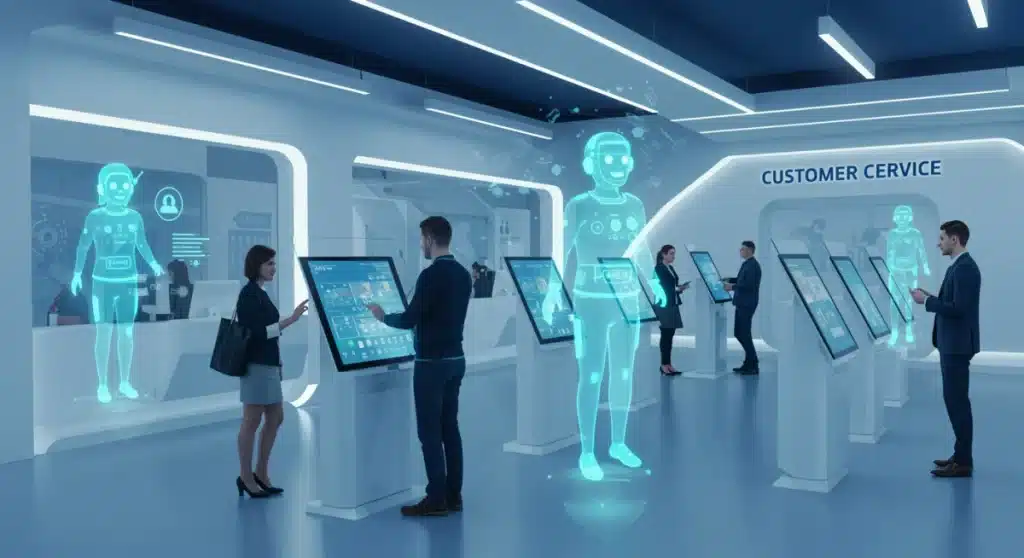
By 2026, AI will fundamentally reshape consumer services, with customer support becoming more efficient through automated interactions, personalized experiences, and predictive assistance, requiring consumers to adapt to new engagement methods.
The landscape of consumer services is undergoing a profound transformation, with artificial intelligence at its core. By 2026, AI customer services 2026 will redefine how we interact with brands, offering both unprecedented efficiency and new challenges for consumers seeking assistance. Understanding these shifts is crucial for navigating the future of customer support effectively.
The Dawn of AI-Driven Customer Support: A New Paradigm
The integration of AI into customer service is no longer a futuristic concept but a rapidly evolving reality. By 2026, many of our initial points of contact with companies will be AI-driven, ranging from sophisticated chatbots to voice assistants capable of understanding complex queries. This shift promises faster resolution times and 24/7 availability, changing consumer expectations.
Early AI applications in customer service were often clunky and frustrating, leading to a perception that AI lacked the nuance of human interaction. However, advances in natural language processing (NLP) and machine learning have dramatically improved AI’s ability to comprehend context, sentiment, and intent. This evolution means that by 2026, AI will be a much more capable and empathetic first line of defense for customer inquiries.
Automated First Contact and Triage
One of the most significant changes will be in how initial customer interactions are handled. AI systems will excel at triaging requests, directing customers to the most appropriate resources, whether that’s a knowledge base article, a specialized human agent, or an automated resolution path.
- Instant Responses: AI chatbots provide immediate answers to frequently asked questions, reducing wait times.
- Intelligent Routing: Complex issues are quickly identified and routed to human experts, minimizing customer frustration.
- Proactive Support: AI can monitor product usage and identify potential problems before the customer even notices, offering solutions proactively.
The goal is not to replace human interaction entirely but to optimize it, allowing human agents to focus on more complex, high-value interactions that require genuine empathy and problem-solving skills. This hybrid approach ensures that customers receive efficient service while still having access to human support when needed.
Personalization at Scale: AI’s Role in Tailored Experiences
In 2026, AI will move beyond generic responses to deliver highly personalized customer experiences. By analyzing vast amounts of data, AI systems will understand individual customer preferences, purchase history, and past interactions, enabling them to offer tailored advice and solutions. This level of personalization aims to make each customer feel understood and valued.
This deep personalization extends to product recommendations, service offerings, and even the tone of communication. Imagine an AI remembering your specific product configurations, your preferred communication channel, and even your past frustrations, using this information to anticipate your needs and provide a more relevant and satisfying interaction.
Predictive Customer Service
AI’s ability to analyze patterns and predict future behavior will be a game-changer. Companies will use AI to anticipate customer needs and proactively offer support or solutions before issues even arise. This could mean sending a notification about a potential service outage, suggesting an upgrade based on usage patterns, or offering a tutorial on a feature you’re likely to use next.
- Anticipatory Solutions: AI identifies potential problems based on usage data and offers solutions before they impact the customer.
- Personalized Offers: Tailored promotions and product suggestions are delivered based on individual preferences and behavior.
- Contextual Understanding: AI remembers past interactions, eliminating the need for customers to repeat information.
The shift towards predictive customer service means less reactive problem-solving and more proactive relationship building. This not only enhances customer satisfaction but also fosters loyalty by demonstrating that companies genuinely understand and care about their customers’ experiences.
Navigating AI Interactions: Tips for Consumers in 2026
As AI becomes more prevalent in customer service, consumers will need to adapt their approach to getting the best help. Understanding how AI systems operate and knowing the most effective ways to communicate with them will be key to efficient problem resolution. It’s about learning to speak the AI’s language, so to speak, while also knowing when to escalate to a human.
One critical aspect is being clear and concise in your initial queries. While AI has improved significantly, overly vague or complex statements can still confuse the system. Providing specific details and keywords will help the AI accurately interpret your request and direct you to the right solution or agent.
Effective Communication with AI
When interacting with AI, clarity is paramount. Avoid slang, jargon, or overly emotional language, as these can sometimes be misinterpreted. Stick to straightforward questions and provide all relevant information upfront.
- Be Specific: Clearly state your issue or question.
- Use Keywords: Employ terms related to your problem that the AI is likely to recognize.
- Provide Context: Offer necessary details without overwhelming the system.
Knowing when to ask for a human agent is also crucial. While AI can handle many tasks, some situations still require human empathy, complex decision-making, or creative problem-solving. Don’t hesitate to request a transfer if the AI isn’t understanding your issue or if you feel a human touch is necessary.
Ethical Considerations and Data Privacy in AI Customer Service
The widespread adoption of AI in consumer services brings with it significant ethical considerations, particularly concerning data privacy and algorithmic bias. By 2026, consumers will be more aware of how their data is used to power these AI systems, and companies will face increased scrutiny regarding their data handling practices. Transparency will be paramount.
AI systems learn from the data they are fed, and if that data contains biases, the AI can perpetuate or even amplify them. This could lead to discriminatory service or unfair outcomes for certain customer demographics. Companies must actively work to ensure their AI models are trained on diverse and unbiased datasets, and that ethical guidelines are strictly adhered to.

Ensuring Fair and Secure AI Interactions
Data privacy regulations will continue to evolve, placing greater responsibility on companies to protect customer information. Consumers will expect clear explanations of how their data is collected, stored, and used by AI systems, and they will demand greater control over their personal information.
- Data Anonymization: Companies must prioritize anonymizing data used for AI training to protect individual privacy.
- Algorithmic Audits: Regular audits of AI algorithms are necessary to detect and mitigate biases.
- Transparent Policies: Clear and accessible privacy policies will build consumer trust.
Ultimately, the success of AI in customer services hinges on building and maintaining consumer trust. This means not only delivering efficient and personalized service but also doing so in a way that is ethical, transparent, and respectful of individual privacy rights.
The Human Element: Where Agents Still Shine in an AI World
Despite the advancements in AI, the human element in customer service will remain indispensable in 2026. While AI excels at routine tasks and data processing, human agents bring a unique set of skills that AI cannot replicate: empathy, nuanced problem-solving, and the ability to handle highly emotional or complex situations. Their role will evolve, becoming more specialized and strategic.
Instead of being bogged down by repetitive queries, human agents will focus on intricate cases, relationship management, and providing a personalized touch that builds strong customer loyalty. They will act as experts, consultants, and empathetic listeners, handling situations where emotional intelligence is key.
Evolving Roles for Customer Service Professionals
The job description of a customer service agent will shift significantly. Agents will require advanced training in critical thinking, emotional intelligence, and complex problem-solving. They will also need to be proficient in collaborating with AI systems, using AI tools to augment their capabilities rather than being replaced by them.
- Complex Problem Resolution: Handling multi-faceted issues that require creative solutions.
- Empathy and Emotional Support: Providing comfort and understanding in sensitive situations.
- Relationship Building: Fostering long-term customer loyalty through personalized interactions.
The future of customer service is a collaborative one, where AI and human agents work in tandem. AI handles the volume and efficiency, while humans provide the depth, warmth, and strategic insight that are essential for exceptional customer experiences.
Future Trends and What to Prepare For
Looking beyond 2026, the evolution of AI in consumer services will continue at an accelerating pace. We can anticipate even more seamless integrations, with AI becoming virtually invisible in the background, constantly optimizing and personalizing our interactions. Augmented reality (AR) and virtual reality (VR) will also begin to play a more significant role, offering immersive support experiences.
The concept of a ‘digital twin’ for customers, where an AI maintains a comprehensive, real-time profile of your preferences and needs, could become more common. This would allow for hyper-personalized service across all touchpoints, from online browsing to in-store assistance. The line between online and offline customer service will blur further, creating a unified experience.
Emerging Technologies and Their Impact
Voice AI will become indistinguishable from human voices, making phone interactions more natural and efficient. Biometric authentication will enhance security and streamline identity verification, reducing friction in sensitive transactions. The focus will be on creating effortless and intuitive customer journeys.
- Metaverse Support: AR/VR will offer immersive troubleshooting and product demonstrations.
- AI-Powered Self-Service: More advanced self-service options will empower customers to resolve issues independently.
- Hyper-Personalization: AI will anticipate needs with extreme precision, offering solutions before they are even articulated.
Preparing for these trends involves continuous learning and adaptation for both consumers and businesses. For consumers, it means embracing new technologies and understanding how to leverage them. For businesses, it means investing in ethical AI development and fostering a culture of continuous improvement in their service offerings.
| Key Aspect | Description in 2026 |
|---|---|
| AI-Driven Initial Contact | Sophisticated chatbots and voice AI handle most routine inquiries and triage complex issues efficiently. |
| Personalized Experiences | AI leverages data to offer highly tailored advice, product recommendations, and proactive support. |
| Human Agent Evolution | Human agents focus on complex, empathetic, and strategic interactions, supported by AI tools. |
| Consumer Adaptation | Consumers need to learn effective communication with AI and understand when to escalate to human support. |
Frequently Asked Questions About AI in Customer Service
By 2026, AI will primarily streamline initial customer contact, offering instant responses, intelligent routing of queries, and proactive support. It will handle routine tasks, freeing human agents to focus on complex, empathy-driven interactions, thus enhancing overall efficiency and customer satisfaction.
Yes, AI can significantly personalize customer experiences by analyzing vast amounts of data, including past interactions and purchase history. This allows AI systems to offer tailored recommendations, predictive solutions, and contextual understanding, making each customer interaction feel more relevant and individualized.
To get the best help, consumers should be clear and concise in their communication, use specific keywords related to their issue, and provide necessary context upfront. Knowing when to request a human agent for complex or emotionally charged issues is also crucial for effective resolution.
No, human customer service agents will not become obsolete. Their roles will evolve, focusing on complex problem-solving, empathetic engagement, and strategic relationship building. AI will handle routine tasks, allowing humans to apply their unique emotional intelligence and critical thinking skills where they are most needed.
Key ethical concerns include data privacy and algorithmic bias. Companies must ensure transparency in data usage, protect customer information, and actively work to mitigate biases in AI training data to prevent discriminatory service and maintain consumer trust in AI-powered interactions.
Conclusion
The impact of AI on consumer services by 2026 will be profound, fundamentally reshaping how customers interact with businesses and receive support. From highly efficient AI-driven first contacts to deeply personalized experiences and predictive assistance, the future promises a more seamless and intuitive customer journey. While AI will handle the bulk of routine inquiries, the human element will remain vital for complex, empathetic interactions. Consumers who understand how to effectively engage with AI and recognize when human intervention is necessary will be best positioned to navigate this evolving landscape and secure optimal service. The ongoing evolution of AI demands continuous adaptation and a commitment to ethical implementation to ensure a truly beneficial future for all.