Navigating 2026 Tax Code Changes: A Financial Planner’s Essential Guide

As we approach the mid-decade mark, the financial landscape is once again poised for significant shifts. For financial planners and their clients, understanding and preparing for the 2026 Tax Code Changes is not merely an option but a critical imperative. These impending alterations to the tax code are expected to have far-reaching implications, affecting everything from individual income tax rates and deductions to estate planning and business taxation. Proactive planning is the cornerstone of effective wealth management, and staying ahead of these changes will be key to minimizing tax burdens and optimizing financial outcomes for your clients.
The Tax Cuts and Jobs Act (TCJA) of 2017 brought about a sweeping overhaul of the U.S. tax system, introducing a multitude of provisions that reshaped how individuals and businesses calculated their tax liabilities. While many of these changes were permanent, a significant number of provisions, particularly those affecting individual taxpayers, are set to expire at the end of 2025. This expiration is the primary driver behind the anticipated 2026 Tax Code Changes, signaling a return to pre-TCJA tax law unless new legislation is enacted. For financial planners, this presents both challenges and opportunities. The challenge lies in navigating the uncertainty and complexity of potential new legislation or the reversion to older rules. The opportunity, however, is to position yourself as an indispensable guide, helping clients understand these shifts and implement strategies that safeguard their financial well-being.
The Sunset of TCJA Provisions: What to Expect from 2026 Tax Code Changes
At the heart of the forthcoming 2026 Tax Code Changes is the expiration of several key provisions from the TCJA. When these provisions sunset, the tax law will revert to what it was in 2017, adjusted for inflation. This means that many of the familiar tax benefits and structures that clients have grown accustomed to over the past few years will likely vanish or be significantly altered. Understanding these specific expirations is the first step in preparing for the new tax environment.
Individual Income Tax Rates and Brackets
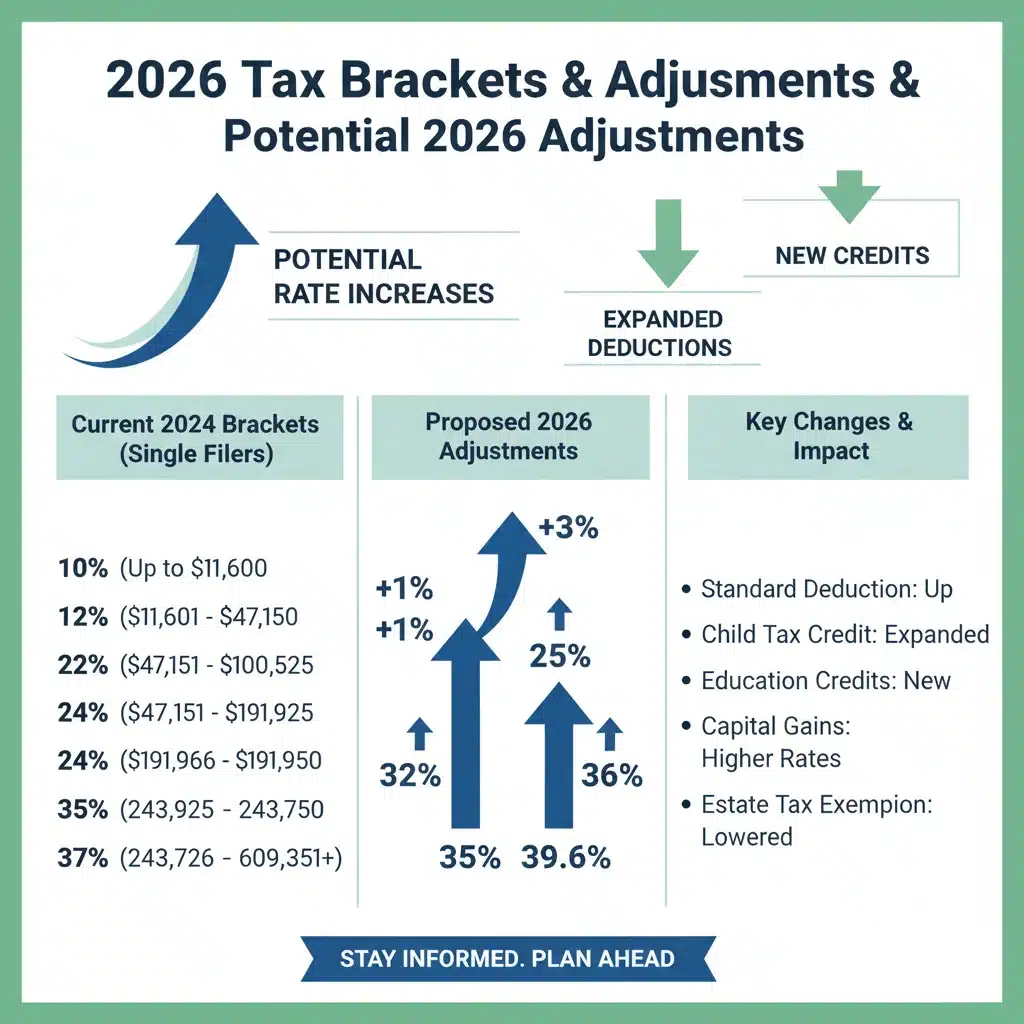
One of the most significant changes expected is the return to pre-TCJA individual income tax rates and brackets. Under the TCJA, marginal tax rates were generally reduced across most income levels, and the number of tax brackets remained seven. With the sunset, we can expect to see a slight increase in tax rates for many brackets, potentially pushing some taxpayers into higher marginal brackets. For instance, the top individual income tax rate, which was reduced to 37% under the TCJA, is scheduled to revert to 39.6%. Similarly, other brackets will see adjustments. Financial planners must model these potential rate changes for their clients, especially those with fluctuating incomes or significant taxable events planned for 2026 or beyond.
Standard Deduction Amounts
The TCJA significantly increased the standard deduction, leading many taxpayers to opt for it rather than itemizing. For the 2023 tax year, the standard deduction for single filers was $13,850, for married couples filing jointly it was $27,700, and for heads of household it was $20,800. These amounts are set to decrease substantially with the expiration of the TCJA provisions, reverting to their pre-2018 levels (adjusted for inflation). This could mean that more clients will find it advantageous to itemize deductions once again. Financial planners should begin reviewing clients’ potential itemized deductions now to assess the impact of a reduced standard deduction and identify opportunities for strategic planning.
State and Local Tax (SALT) Deduction Cap
A contentious provision of the TCJA was the $10,000 cap on the deduction for state and local taxes (SALT). This cap significantly impacted taxpayers in high-tax states. With the sunset of the TCJA, the SALT cap is expected to be removed, allowing taxpayers to deduct an unlimited amount of state and local taxes. This change will be a welcome relief for many clients, but it also means that financial planners need to re-evaluate tax planning strategies that were developed specifically to mitigate the impact of the SALT cap.
Child Tax Credit and Other Family-Related Credits
The TCJA also expanded the Child Tax Credit (CTC), increasing it to $2,000 per qualifying child and making a portion of it refundable. While there have been temporary expansions since then, the baseline TCJA increase is also subject to sunset. This means the CTC could revert to $1,000 per child, with stricter refundability rules. Other family-related credits and deductions may also be affected. Financial planners should analyze how these changes will impact families with children, particularly those who relied heavily on the expanded CTC for their financial planning.
Estate and Gift Tax Exemption
Perhaps one of the most significant expirations for high-net-worth clients is the substantial increase in the estate and gift tax exemption. Under the TCJA, the exemption effectively doubled, reaching $12.92 million per individual in 2023. This allowed many affluent families to transfer significant wealth free of federal estate and gift taxes. In 2026, this exemption is scheduled to revert to its pre-TCJA level of $5 million per individual, adjusted for inflation. This reduction will bring many more estates back into the federal estate tax net, making proactive estate planning an urgent priority. Financial planners must work with clients to utilize the higher exemption amounts while they are still available, exploring strategies such as lifetime gifting and establishing trusts.
Strategic Planning for Financial Planners Amidst 2026 Tax Code Changes
The impending 2026 Tax Code Changes demand a proactive and strategic approach from financial planners. This is an opportune moment to deepen client relationships by providing invaluable guidance and demonstrating your expertise in navigating complex tax environments. Here are key areas where financial planners can focus their efforts:
1. Re-evaluating Income and Deduction Strategies
With potential changes to tax rates and the standard deduction, financial planners should immediately begin reviewing clients’ income and deduction profiles. This involves:
- Tax Loss Harvesting: If capital gains are anticipated in future years, consider harvesting tax losses in the current, potentially lower-tax environment to offset future gains.
- Income Acceleration/Deferral: For clients expecting to be in a higher tax bracket in 2026, consider accelerating income into 2025 where feasible. Conversely, if 2026 rates are expected to be lower for a particular client, deferring income might be beneficial. This is particularly relevant for bonuses, stock options, and self-employment income.
- Itemized vs. Standard Deduction Analysis: Re-run projections for clients to determine whether itemizing deductions will become more advantageous in 2026. Advise clients on strategies to bunch deductions (e.g., charitable contributions) into alternating years to maximize their tax benefits.
- Charitable Giving Strategies: Explore Donor-Advised Funds (DAFs) as a way to make a large charitable contribution in a high-income year (like 2025) and receive an immediate tax deduction, while distributing the funds to charities over time. This can be especially useful if the standard deduction decreases.
2. Optimizing Retirement Planning Contributions
Retirement accounts offer powerful tax advantages that can be strategically utilized in anticipation of the 2026 Tax Code Changes. Financial planners should consider:
- Roth Conversions: For clients who anticipate being in a higher tax bracket in 2026 and beyond, converting a portion of their traditional IRA or 401(k) to a Roth IRA in 2024 or 2025 might be highly beneficial. While the conversion is a taxable event, paying taxes at potentially lower current rates could lead to significant tax savings in retirement, as Roth distributions are tax-free.
- Maximizing Contributions: Encourage clients to maximize contributions to tax-advantaged retirement accounts (401(k)s, IRAs) in the years leading up to 2026. This reduces current taxable income and allows for tax-deferred growth.
- Backdoor Roth Contributions: For high-income earners who are phased out of direct Roth IRA contributions, the backdoor Roth strategy remains a viable option. Planners should ensure clients understand the pro-rata rule if they have existing pre-tax IRA balances.
3. Proactive Estate Planning Adjustments
The potential reduction in the estate and gift tax exemption is a monumental consideration for affluent clients. Financial planners must engage in urgent estate planning discussions:
- Utilizing the Higher Exemption: Advise clients to consider making substantial lifetime gifts in 2024 and 2025 to utilize the current, higher gift tax exemption. This can involve direct gifts to individuals or funding irrevocable trusts. The IRS has confirmed that gifts made under the higher exemption will not be clawed back if the exemption amount decreases.
- Reviewing Existing Estate Plans: Estate plans drafted under the assumption of a higher exemption may need significant revisions. This includes wills, trusts, and beneficiary designations.
- Grantor Retained Annuity Trusts (GRATs): Explore GRATs as a strategy to transfer appreciating assets to beneficiaries with minimal gift tax implications, especially in a low-interest-rate environment.
- Irrevocable Life Insurance Trusts (ILITs): ILITs can be an effective tool to remove life insurance proceeds from a client’s taxable estate, providing liquidity for estate taxes or other needs.
4. Business Tax Considerations for 2026 Tax Code Changes
While many TCJA business provisions were permanent, some aspects could be influenced by a broader tax bill. Financial planners serving business owners should:
- Qualified Business Income (QBI) Deduction: The 20% QBI deduction for pass-through entities is set to expire. This could significantly impact the after-tax income of many small business owners and independent contractors. Planners should evaluate business structures and income recognition strategies.
- Depreciation Rules: While bonus depreciation is already phasing out, any new legislation could impact depreciation schedules and capital expenditure planning.
- Entity Structure Review: Re-evaluate the optimal business entity structure (S-Corp, C-Corp, LLC) in light of anticipated changes to individual and corporate tax rates.
5. Investment Portfolio Management with a Tax Lens
Tax-efficient investing strategies become even more critical when facing significant tax code changes. Financial planners should:
- Asset Location: Strategically place different types of assets in different account types (taxable, tax-deferred, tax-free) to maximize after-tax returns. For example, high-income-producing assets might be better suited for tax-advantaged accounts.
- Capital Gains Planning: Advise clients on managing capital gains and losses, especially if capital gains tax rates are expected to change. Consider realizing gains in a potentially lower tax year if a rate hike is anticipated.
- Municipal Bonds: For clients in high tax brackets, tax-exempt municipal bonds may become even more attractive if income tax rates increase.
Communicating with Clients About the 2026 Tax Code Changes
Effective communication is paramount. Clients will likely be concerned or confused by the impending 2026 Tax Code Changes. Financial planners should proactively reach out and provide clear, concise, and actionable information.
- Hold Educational Webinars/Seminars: Offer sessions to explain the potential changes and their implications.
- Individualized Consultations: Schedule one-on-one meetings to review each client’s specific situation and tailor advice.
- Clear Explanations: Avoid jargon and explain complex tax concepts in an understandable way. Use analogies and real-world examples.
- Scenario Planning: Present clients with different scenarios based on potential legislative outcomes to help them visualize the impact and prepare for various possibilities.
- Emphasize Proactivity: Stress the importance of acting now to take advantage of current tax laws before they expire.
The political landscape will undoubtedly play a significant role in the final form of the 2026 Tax Code Changes. While a full reversion to pre-TCJA law is the default, there’s always the possibility of new legislation being passed that modifies or extends some of the current provisions. Financial planners must remain vigilant, monitoring legislative developments and being prepared to adjust strategies as new information emerges. Subscribing to reputable tax news services, attending professional development courses, and engaging with tax policy experts are all crucial for staying informed.
Potential New Legislation and Its Impact
While the sunset of TCJA provisions is the primary driver, it’s also plausible that Congress could enact new tax legislation before or during 2026. This could involve:
- Extending TCJA Provisions: Some or all of the expiring provisions could be extended, either permanently or temporarily. This would likely depend on the political climate and the economic outlook.
- New Tax Initiatives: Policymakers might introduce new tax credits, deductions, or even new taxes to address specific economic or social goals. For example, discussions around wealth taxes, changes to capital gains taxation, or adjustments to corporate tax rates could resurface.
- Changes to Retirement Account Rules: There’s always a possibility of adjustments to contribution limits, distribution rules, or the tax treatment of various retirement vehicles.
Financial planners must adopt a flexible planning approach, building in contingencies for different legislative outcomes. This might involve creating ‘if-then’ scenarios for clients’ financial plans, allowing for swift adjustments once the final tax landscape for 2026 becomes clear.

The Role of Technology in Navigating 2026 Tax Code Changes
In this era of complex tax legislation, technology plays an increasingly vital role for financial planners. Utilizing advanced financial planning software and tax projection tools can significantly enhance your ability to serve clients effectively during the 2026 Tax Code Changes.
- Tax Projection Software: These tools allow planners to model various tax scenarios for clients, showing the impact of different income levels, deductions, and investment strategies under both current and projected 2026 tax laws. This helps clients visualize the consequences of inaction and the benefits of proactive planning.
- Client Relationship Management (CRM) Systems: A robust CRM helps track client specific tax situations, historical data, and communication records, ensuring personalized and timely advice.
- Data Aggregation Platforms: Tools that aggregate all of a client’s financial data (investments, banking, liabilities) in one place make it easier to get a holistic view and identify tax planning opportunities.
- Automated Tax Alerts: Subscribing to services that provide automated alerts on legislative changes can help planners stay updated without constant manual monitoring.
Embracing these technological solutions not only improves efficiency but also allows financial planners to provide more sophisticated and accurate advice, solidifying their position as trusted advisors.
Conclusion: Empowering Clients Through the 2026 Tax Code Changes
The impending 2026 Tax Code Changes represent a significant juncture for financial planning. While the exact details of the future tax landscape remain somewhat fluid, the scheduled expiration of key TCJA provisions provides a clear roadmap for many of the adjustments clients will face. For financial planners, this period is an opportunity to shine – to demonstrate foresight, expertise, and a commitment to protecting and enhancing client wealth.
By proactively engaging with clients, re-evaluating existing financial and estate plans, and implementing strategic adjustments in areas like income management, retirement contributions, and investment portfolios, you can help clients navigate the complexities ahead. The emphasis should be on clear communication, personalized advice, and continuous monitoring of legislative developments. Those who embrace these principles will not only help their clients mitigate potential tax burdens but will also strengthen their professional relationships, ensuring long-term trust and success in an ever-evolving financial world.
The time to prepare for the 2026 Tax Code Changes is now. By taking decisive action and offering informed guidance, financial planners can empower their clients to face the future with confidence, turning potential challenges into opportunities for optimized financial well-being.