Maximize 2026 Social Security Benefits: Your 15% Payout Boost Guide

Navigating 2026 Social Security Benefits: Key Changes and Maximizing Your Payouts by 15%
Are you approaching retirement or already enjoying its golden years? Understanding and optimizing your 2026 Social Security Benefits is paramount to securing your financial future. As the landscape of Social Security continually evolves, staying informed about upcoming changes and strategic claiming options can significantly impact your monthly payouts. This comprehensive guide is designed to equip you with the knowledge and actionable strategies to potentially boost your Social Security income by up to 15% in 2026 and beyond. We’ll delve into the projected adjustments, eligibility criteria, and expert tips to ensure you make the most informed decisions for a comfortable and secure retirement.
Social Security remains a cornerstone of retirement planning for millions of Americans. However, its complexities often leave beneficiaries feeling overwhelmed. The good news is that with careful planning and a clear understanding of the rules, you can navigate these complexities to your advantage. Our focus today is on the projected outlook for 2026 Social Security Benefits, including any anticipated Cost-of-Living Adjustments (COLAs), changes in the full retirement age, and how your personal earning history plays a crucial role. By the end of this article, you’ll have a roadmap to potentially enhance your benefits, making your retirement dreams a more tangible reality.
Understanding the Foundation: How Social Security Benefits Are Calculated
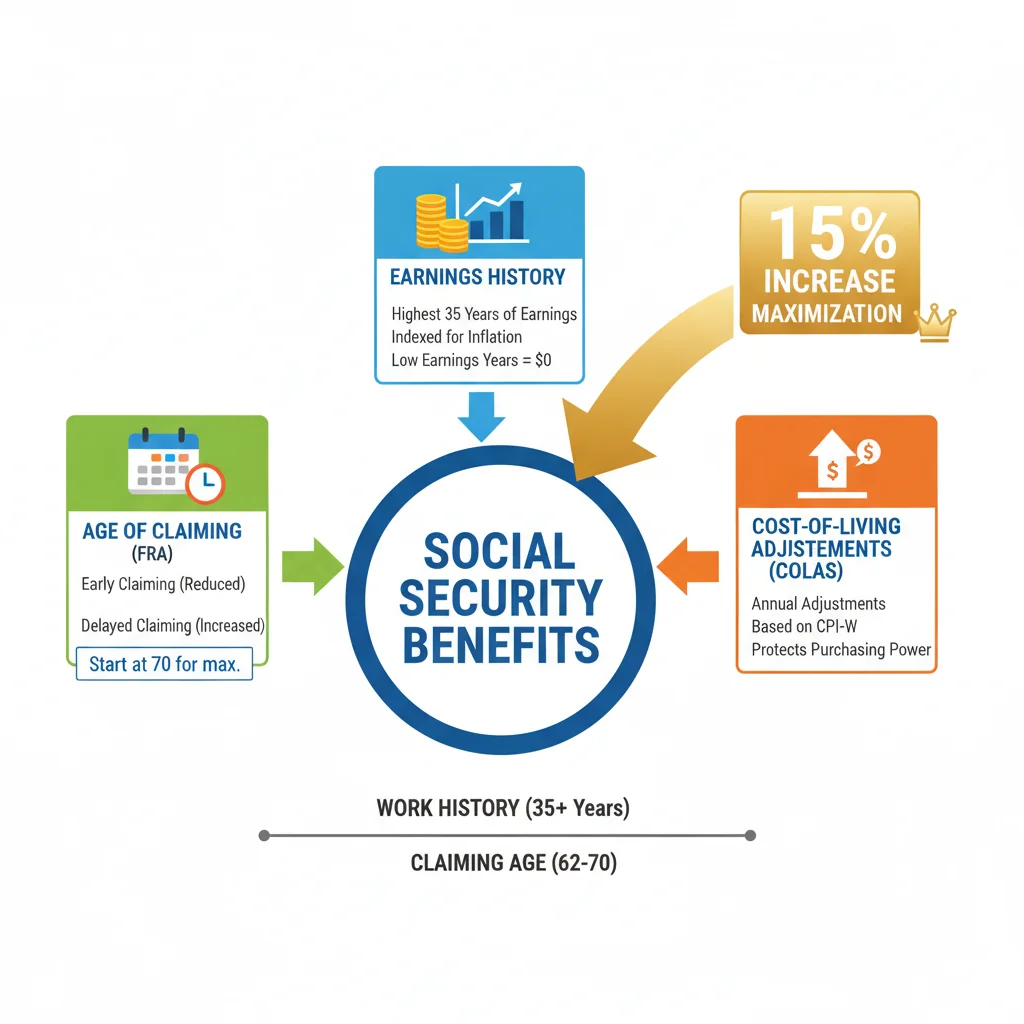
Before we dive into the specifics of 2026 Social Security Benefits, it’s essential to grasp the fundamental principles governing how your benefits are calculated. Your Social Security benefit amount is primarily based on your average indexed monthly earnings (AIME) during your 35 highest-earning years. The Social Security Administration (SSA) applies a formula to your AIME to determine your primary insurance amount (PIA), which is the benefit you would receive if you claim at your full retirement age (FRA).
Several factors influence this calculation:
- Years of Earnings: You need at least 40 credits (10 years of work) to be eligible for retirement benefits. The SSA considers your highest 35 years of earnings; if you have fewer than 35 years, zero-earning years will be averaged in, potentially lowering your benefit.
- Indexed Earnings: Your past earnings are ‘indexed’ to account for changes in average wages over time. This ensures that your past earnings are compared fairly with current wage levels.
- Full Retirement Age (FRA): This is the age at which you are entitled to 100% of your PIA. For those born in 1960 or later, the FRA is 67. Claiming benefits before your FRA results in a permanent reduction, while delaying beyond your FRA can lead to increased benefits.
- Cost-of-Living Adjustments (COLAs): These annual adjustments are designed to help Social Security benefits keep pace with inflation. COLAs are typically announced in October and take effect in January of the following year. While the 2026 COLA is still speculative, it will play a significant role in the actual benefit amounts received.
Understanding these core components is the first step in strategically planning for your 2026 Social Security Benefits. Each element offers an opportunity for optimization, which we will explore in detail.
Projected Changes and What They Mean for Your 2026 Social Security Benefits
While definitive figures for 2026 Social Security Benefits are still some time away, we can anticipate certain trends and potential changes based on current economic forecasts and historical patterns. Key areas to watch include:
Cost-of-Living Adjustments (COLAs) for 2026
The COLA is arguably the most significant annual adjustment to Social Security benefits. It’s based on the Consumer Price Index for Urban Wage Earners and Clerical Workers (CPI-W). A higher inflation rate generally translates to a larger COLA. While predicting the exact 2026 COLA is speculative, economists and financial analysts will closely monitor inflation trends throughout 2025 to project the likely increase. Even a modest COLA can compound over time, significantly impacting your total lifetime benefits.
Changes in Full Retirement Age (FRA)
For individuals born in 1960 or later, the full retirement age is 67. This has been gradually increasing and is now stable at 67. There are no current legislative proposals that suggest a change to the FRA for those claiming 2026 Social Security Benefits. However, it’s always wise to reconfirm your specific FRA based on your birth year directly with the SSA or through their online tools.
Maximum Taxable Earnings
Each year, there’s a cap on the amount of earnings subject to Social Security taxes, known as the maximum taxable earnings. This limit typically increases annually with average wage growth. For 2026, we can expect this limit to be higher than previous years. This primarily affects high-income earners, as earnings above this threshold are not subject to Social Security taxes and do not count towards your benefit calculation. While it doesn’t directly alter your benefit formula, it’s an important consideration for those still working and planning their retirement contributions.
Changes to the Earnings Test
If you claim Social Security benefits before your full retirement age and continue to work, your benefits may be reduced if your earnings exceed certain limits. This is known as the earnings test. These limits are also adjusted annually. For 2026 Social Security Benefits, expect these thresholds to increase. Once you reach your FRA, the earnings test no longer applies, and you can earn any amount without your benefits being reduced.
Staying abreast of these potential changes is crucial for anyone planning to claim or already receiving 2026 Social Security Benefits. These adjustments, though seemingly minor individually, can collectively influence your overall financial security in retirement.
Strategic Claiming: Maximizing Your 2026 Social Security Benefits by 15%
Now for the exciting part: how to strategically maximize your 2026 Social Security Benefits. While a guaranteed 15% increase is a target, various strategies can significantly boost your payouts. The key lies in understanding your options and making informed decisions tailored to your personal circumstances.
1. Delaying Your Claim: The Power of Delayed Retirement Credits
This is arguably the most impactful strategy for increasing your Social Security benefits. For every year you delay claiming benefits past your full retirement age (up to age 70), your benefit amount increases by 8% per year. These are called Delayed Retirement Credits (DRCs). This means if your FRA is 67, and you delay claiming until age 70, you could receive a 24% increase over your PIA. This strategy alone can easily contribute to, or even exceed, the target 15% increase in your 2026 Social Security Benefits.
Consider the following:
- Full Retirement Age (FRA) at 67: If your PIA is $2,000 at age 67.
- Delay to 68: Your benefit increases by 8% to $2,160.
- Delay to 69: Your benefit increases another 8% (on the original PIA) to $2,320.
- Delay to 70: Your benefit increases another 8% to $2,480.
In this scenario, delaying from 67 to 70 results in a $480 monthly increase, which is a 24% boost. While not everyone can or wants to delay, understanding the significant financial advantage is critical for maximizing your 2026 Social Security Benefits.
2. Optimizing Your Earnings Record: The 35-Year Rule
Remember that your benefits are based on your 35 highest-earning years. If you have fewer than 35 years of work, or if some of your earlier earning years were low, continuing to work can significantly improve your average indexed monthly earnings (AIME). By replacing a low-earning or zero-earning year with a higher-earning year, you can directly increase your PIA and, consequently, your 2026 Social Security Benefits.
Even if you’re already retired, consider part-time work or consulting if it’s feasible and enjoyable. The additional income not only supplements your current finances but could also enhance your future Social Security checks.
3. Coordinated Spousal Benefits and Survivor Benefits
For married couples, divorced individuals, and widows/widowers, there are advanced claiming strategies that can significantly boost household Social Security income. These strategies often involve coordinating when each spouse claims their benefits.
- Spousal Benefits: If your spouse has a higher earning record, you might be eligible for a spousal benefit, which can be up to 50% of their full retirement age benefit. You can claim a spousal benefit even if you haven’t worked or if your own benefit is less than half of your spouse’s.
- "File and Suspend" (for those eligible before 2016): While largely eliminated, some individuals born before January 2, 1954, might still be able to use this strategy, allowing one spouse to file for benefits, enabling the other to claim spousal benefits, while the first spouse’s own benefit continues to grow due to delayed retirement credits.
- Restricted Application for Spousal Benefits (for those born before January 2, 1954): This allows an individual to claim only spousal benefits at their FRA, while their own benefit continues to grow until age 70. This can be a powerful tool for maximizing combined household benefits.
- Survivor Benefits: If your spouse passes away, you may be eligible for survivor benefits, which can be up to 100% of their benefit amount. It’s often strategic to claim one benefit (e.g., survivor) while letting your own benefit grow, then switch to the higher benefit later.
These strategies are complex and highly dependent on birth dates and individual earnings records. Consulting with a financial advisor specializing in Social Security can be invaluable for couples looking to optimize their 2026 Social Security Benefits.
Factors Influencing Your 2026 Social Security Benefits Beyond Your Control
While you can control when you claim and how long you work, certain factors influencing your 2026 Social Security Benefits are largely outside your direct influence. Understanding these can help set realistic expectations.
The Economic Climate and COLAs
As mentioned, the annual COLA is tied to inflation. A robust economy with moderate inflation tends to lead to positive COLAs, helping your benefits maintain their purchasing power. Conversely, periods of low inflation or deflation can result in minimal or no COLA. While you can’t control the economy, staying informed about economic forecasts can help you anticipate potential adjustments to your 2026 Social Security Benefits.
Legislative Changes
Social Security is a dynamic program, and it’s always subject to potential legislative reforms. Discussions about the program’s long-term solvency are ongoing. While significant changes impacting current beneficiaries or those nearing retirement are typically phased in over many years, it’s crucial to stay aware of any proposed legislation that could affect future benefit calculations or eligibility for 2026 Social Security Benefits.
The Windfall Elimination Provision (WEP) and Government Pension Offset (GPO)
If you receive a pension from employment not covered by Social Security (e.g., some government jobs) and also have Social Security-covered earnings, the WEP or GPO might reduce your Social Security benefits or spousal/survivor benefits. These provisions are designed to prevent "windfall" benefits for individuals who also have non-covered pensions. If these apply to you, understanding their impact on your 2026 Social Security Benefits is crucial for accurate financial planning.
Practical Steps to Prepare for Your 2026 Social Security Benefits
Preparation is key to ensuring you maximize your 2026 Social Security Benefits. Here’s a checklist of practical steps you can take:
1. Create a "My Social Security" Account
This is your primary tool for managing your Social Security information. Through your online account, you can:
- Review your earnings record to ensure accuracy. Any discrepancies should be reported to the SSA immediately.
- Get estimates of your future benefits at different claiming ages.
- Access your Social Security Statement.
- Apply for benefits online.
Regularly checking your earnings record is vital. Errors can occur, and correcting them before you claim your 2026 Social Security Benefits can prevent significant headaches and potentially increase your payout.
2. Understand Your Full Retirement Age (FRA)
Knowing your precise FRA is the cornerstone of any claiming strategy. Use the SSA’s online tools or consult their publications to confirm your FRA based on your birth year. This will directly inform your decision about when to start receiving your 2026 Social Security Benefits.
3. Evaluate Your Financial Situation
Consider your overall financial picture. Do you have sufficient retirement savings to bridge the gap if you delay claiming Social Security? What are your projected expenses in retirement? Your other income sources (pensions, 401(k)s, IRAs) will influence whether delaying Social Security is a viable and beneficial strategy for your 2026 Social Security Benefits.
4. Consult with a Financial Advisor
For complex situations, such as coordinating spousal benefits, navigating WEP/GPO, or planning for survivor benefits, a financial advisor specializing in retirement planning and Social Security can provide invaluable personalized guidance. They can help you model different claiming scenarios and identify the optimal strategy to maximize your 2026 Social Security Benefits based on your unique circumstances.
5. Stay Informed
Regularly check the official Social Security Administration website (SSA.gov) for updates. Economic forecasts and legislative discussions can evolve, potentially impacting future benefits. Subscribing to financial news outlets that cover Social Security topics can also help you stay current on developments relevant to your 2026 Social Security Benefits.

Common Misconceptions About Social Security and 2026 Benefits
Dispelling common myths surrounding Social Security can prevent costly mistakes when planning for your 2026 Social Security Benefits.
Myth: Social Security Will Run Out
While the Social Security trust funds face long-term solvency challenges, the program is not "running out." It’s primarily funded by payroll taxes, meaning as long as people are working, money will flow into the system. Projections indicate that Social Security will be able to pay a significant portion of promised benefits for decades, even if no legislative action is taken. However, reforms may be necessary to ensure 100% of scheduled benefits can be paid in the long run.
Myth: You Must Stop Working to Claim Benefits
This is only partially true. You can work and receive Social Security benefits simultaneously. However, if you are under your full retirement age, your benefits may be reduced if your earnings exceed certain limits (the earnings test). Once you reach your FRA, you can earn any amount without your benefits being affected. This is a crucial distinction when considering your 2026 Social Security Benefits strategy.
Myth: My Benefits Will Automatically Increase by a Fixed Percentage
While delayed retirement credits offer a fixed 8% annual increase for delaying past FRA, the annual COLA is not fixed. It varies each year based on inflation. There’s no automatic fixed-percentage increase beyond the delayed retirement credits. Understanding this nuance is key to accurately projecting your 2026 Social Security Benefits.
Myth: It’s Always Best to Claim as Early as Possible
While some financial situations might necessitate claiming early, it’s rarely "always best." Claiming at age 62 results in a permanent reduction of up to 30% from your PIA. For many, delaying benefits can lead to substantially higher lifetime income, especially if you have good health and a long life expectancy. The optimal claiming age for your 2026 Social Security Benefits depends heavily on your individual circumstances, health, and other financial resources.
The Future of Social Security and Your 2026 Benefits
The long-term outlook for Social Security is a topic of ongoing debate. While the program faces financial challenges, it has proven resilient and adaptable throughout its history. Policymakers are continually exploring options to ensure its solvency for future generations. These discussions may involve adjustments to the full retirement age, changes to the maximum taxable earnings, or modifications to the benefit formula. However, any significant changes are usually implemented gradually, giving individuals ample time to adjust their retirement plans.
For those planning for 2026 Social Security Benefits, the most prudent approach is to focus on the current rules and known projections while staying informed about potential future legislative developments. The strategies outlined in this article – delaying claims, optimizing earnings, and understanding spousal/survivor options – remain the most powerful tools at your disposal for maximizing your benefits.
Conclusion: Empowering Your Retirement with Optimized 2026 Social Security Benefits
Navigating the world of Social Security can seem daunting, but with the right information and strategic planning, you can significantly impact your financial well-being in retirement. Our deep dive into 2026 Social Security Benefits has highlighted the importance of understanding how benefits are calculated, anticipating projected changes, and, most importantly, employing smart claiming strategies.
By considering factors such as delaying your claim until age 70 for substantial delayed retirement credits, optimizing your earnings record, and exploring coordinated spousal or survivor benefits, you are well-positioned to potentially boost your Social Security payouts by 15% or more. Remember to utilize resources like your "My Social Security" account, consult with financial professionals, and stay informed about any legislative updates.
Your retirement security is a journey, not a destination. By proactively planning for your 2026 Social Security Benefits today, you are taking a powerful step towards a more comfortable, predictable, and prosperous future. Don’t leave money on the table – empower yourself with knowledge and make your Social Security work harder for you.